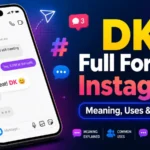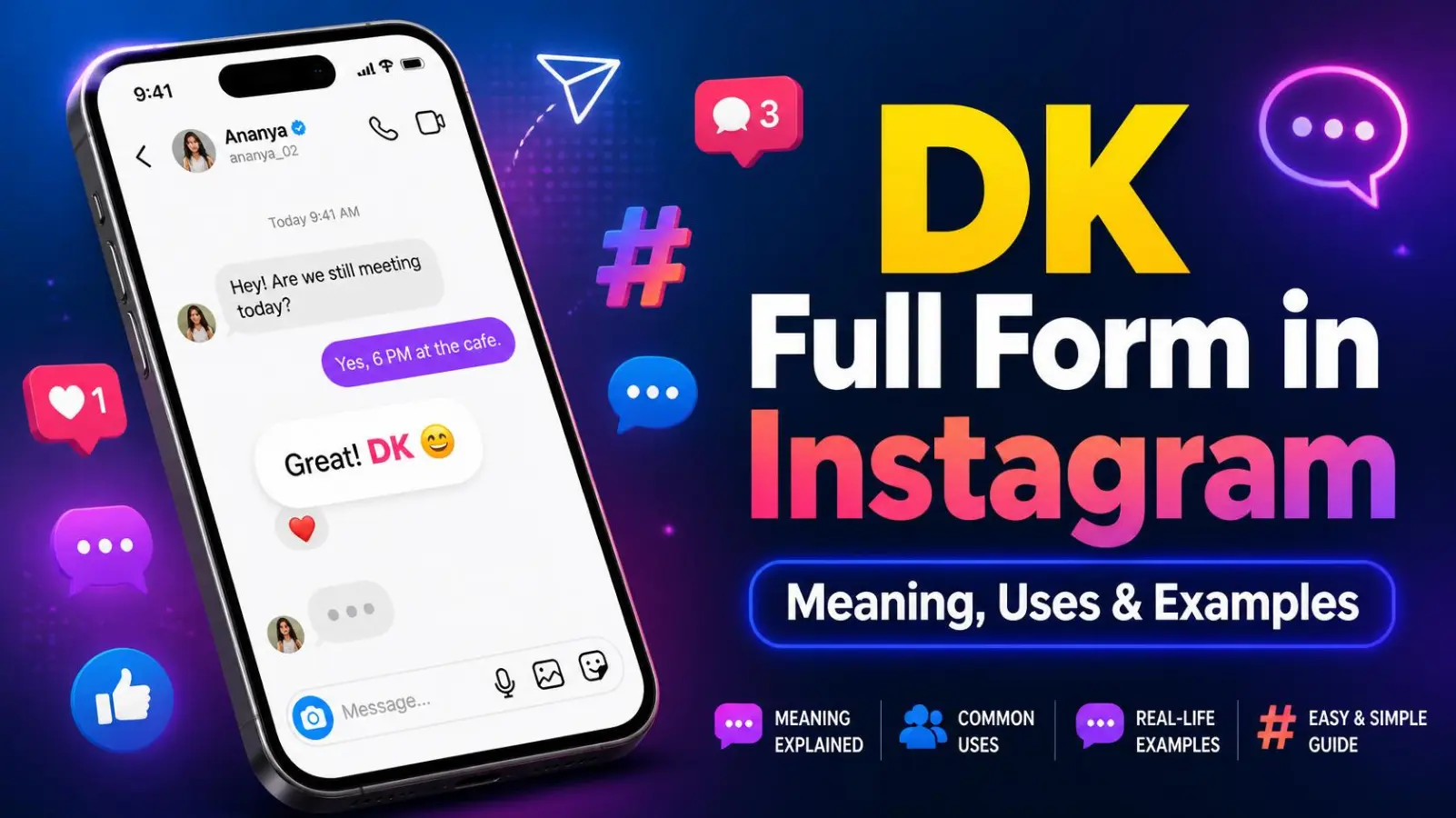
If you’ve been scrolling through Instagram comments or DMs and spotted the letters “DK,” you’ve probably wondered what it stands for. This short, simple acronym pops up constantly in casual conversations, and once you learn it, you’ll start noticing it everywhere. The DK full form in Instagram is “Don’t Know” — a quick, casual way to admit uncertainty or say you don’t have an answer to something.
Instagram thrives on fast, informal communication, and DK fits perfectly into that culture. Whether someone asks a question in the comments, wants an opinion in a DM, or brings up something you genuinely have no information about, DK lets you respond honestly without typing out a full sentence. This guide breaks down the complete DK meaning on Instagram, traces its origin, and walks through exactly how people use it across different platforms and situations.
By the end of this guide, you’ll understand what DK means, how its tone shifts depending on context, which related acronyms often get confused with it, and how to use it naturally in your own conversations. Let’s get into it.
What Does DK Mean on Instagram?
DK stands for “Don’t Know.” People use it to express uncertainty, admit they lack information, or respond to a question they can’t confidently answer. It works the same way “no idea” or “not sure” would in spoken conversation, just shortened for faster typing.
You’ll typically see DK in situations like:
- Someone asks a question you genuinely can’t answer
- Someone wants an opinion on something you haven’t formed a view on yet
- Someone asks about plans, timing, or details you haven’t confirmed
- Someone brings up a topic you’re unfamiliar with
- Someone asks for a recommendation you don’t have
For example, if a friend comments asking where a photo was taken, you might reply: “DK honestly, I just found it on my camera roll lol.”
DK vs. IDK: What’s the Difference?
Instagram users often see the longer, more common version, “IDK,” standing for “I Don’t Know.” DK simply drops the “I,” creating an even shorter version of the same phrase. Both acronyms mean essentially the same thing, and people often use them interchangeably depending on personal texting habits or how quickly they’re typing.
In general, IDK tends to be more widely recognized and used more frequently, while DK shows up as a slightly more compressed, casual variant — especially among users who prioritize speed over completeness.
Where DK Came From
DK doesn’t trace back to a viral post or a specific cultural moment. Like most texting acronyms, it developed naturally out of digital shorthand, where users trim common phrases down to their most essential letters to save time. “I don’t know” has long been one of the most frequently typed phrases in casual conversation, making it a prime candidate for abbreviation.
As texting culture evolved through the 2000s and 2010s, phrases like “I don’t know” shortened first to “IDK,” and later, in even more compressed conversations, to the simplified “DK.” Social platforms like Instagram, Snapchat, and Twitter/X inherited this shorthand from broader texting culture rather than creating it from scratch. Once Instagram’s comment sections and DMs became major hubs for casual conversation, DK naturally carried over as a common response.
How People Use DK Across Platforms
While this guide focuses on Instagram, DK and its close relative IDK show up across nearly every messaging and social platform.
DK on Instagram
Instagram’s comment-and-DM-driven format makes DK a natural fit for:
- Comments, replying to a question another user asked
- Direct messages, admitting uncertainty in a casual conversation
- Story replies, responding to a poll, question sticker, or caption prompt
DK on Snapchat
On Snapchat, DK functions identically, often appearing in quick chat replies when someone asks a question that doesn’t have a clear answer.
DK on TikTok
TikTok users frequently use DK (and more often IDK) in comment sections, especially when reacting to a video that poses a question or asks for an opinion.
DK on Discord and in Gaming Chats
In gaming communities, DK shows up when players don’t have information relevant to the game — strategy, enemy locations, or updates. A teammate might type “dk, haven’t seen them” mid-match, keeping communication fast during gameplay.
DK on Reddit
Reddit comment threads often use DK or IDK when responding to a question posed in a post, especially in casual or off-topic subreddits where brevity is valued over formal explanation.
DK in Everyday Texting
Outside of any specific platform, DK works the same way in regular text messages, particularly among users who prefer shorter, faster typing styles.
DK in Dating Contexts
In dating app conversations or early texting with a romantic interest, DK often shows up when answering casual questions about preferences, plans, or opinions without overexplaining.
DK in the Workplace
DK almost never appears in professional communication. Because it’s casual internet shorthand, using it in work emails or client-facing messages can come across as unprofessional. Full phrases like “I’m not sure” or “I don’t have that information yet” work far better in formal settings.
Tone and Connotation: How DK Feels in Conversation
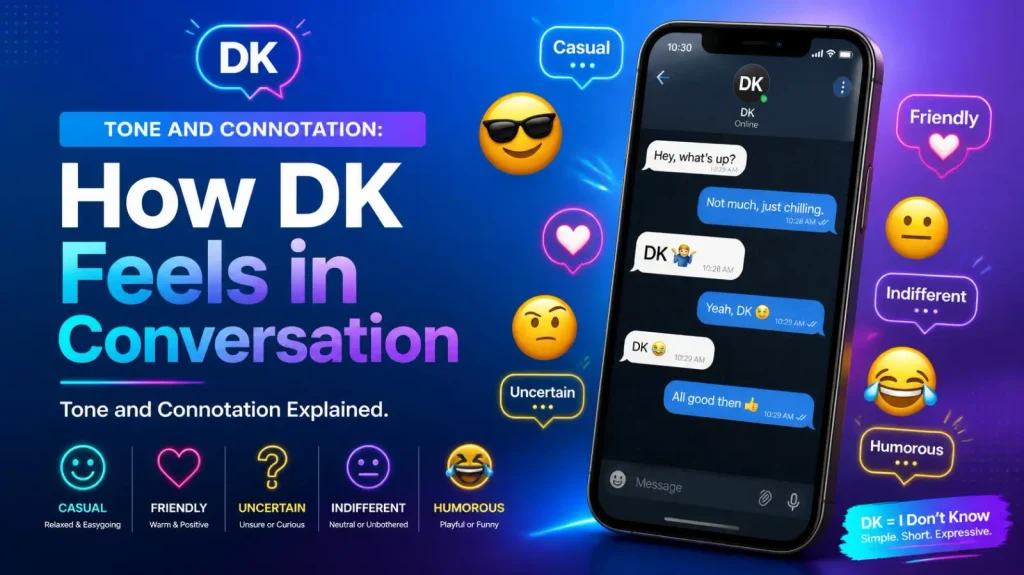
DK carries a neutral, casual tone in most situations, though context can shift its meaning slightly:
- Genuinely uncertain: Most often, DK simply reflects honest uncertainty about a question or topic.
- Dismissive: In some cases, DK can read as a quick brush-off, especially if someone seems uninterested in engaging further with the topic.
- Playful or joking: Among friends, DK sometimes appears in a lighthearted way, especially when responding to a silly or rhetorical question.
Because DK is so brief, tone often depends heavily on the surrounding conversation and relationship between the people involved. Adding extra words (“dk, but let me find out”) helps convey genuine engagement rather than disinterest.
Common Variations and Related Terms
Instagram slang frequently overlaps with broader texting culture. Here are the terms most closely related to DK:
| Term | Meaning | Notes |
| DK | “Don’t Know” | A shortened, casual variant of IDK |
| IDK | “I Don’t Know” | The more common, widely recognized version |
| DKN | “Don’t Know,” sometimes extended | Occasionally used interchangeably with DK |
| NC | “No Comment” | Different meaning, but used in similar uncertain-response contexts |
| TBD | “To Be Determined” | Used specifically for plans or decisions still pending |
| IDC | “I Don’t Care” | Different meaning, but frequently confused with IDK due to similar letters |
DK vs. IDC
These two acronyms look somewhat similar but carry very different meanings:
- DK (“Don’t Know”) — expresses a lack of information or certainty.
- IDC (“I Don’t Care”) — expresses indifference, not uncertainty.
Mixing these up can accidentally change the tone of a message significantly, so it’s worth double-checking which one fits the intended meaning before sending.
Realistic Conversation Examples
Seeing DK in action helps clarify exactly how people use it in everyday Instagram conversations.
Scenario 1: Answering a Comment
Comment: “Where was this taken?” Reply: “DK honestly, my friend picked the spot lol”
Scenario 2: Casual DM Exchange
Friend: “Do you think it’ll rain this weekend?” You: “Dk, haven’t checked the forecast yet”
Scenario 3: Story Reply
Question sticker: “What’s your favorite show right now?” Reply: “Dk, I haven’t watched much lately lol”
Scenario 4: Group Chat
Friend: “Is the event still happening Saturday?” You: “Dk, waiting to hear back”
Scenario 5: Dating Context
Match: “What’s your favorite type of food?” You: “Honestly dk, I like pretty much everything lol”
How to Use DK the Right Way
A few practical tips help you use DK naturally and avoid unintended tone issues:
- Use it for genuine uncertainty. DK works best when you truly don’t have an answer, rather than as a way to avoid engaging.
- Add context when it matters. A quick extra phrase (“dk yet, still figuring it out”) helps DK feel more sincere.
- Skip it in professional settings. Stick to full phrases in formal emails or workplace communication.
- Match the conversation’s energy. DK fits naturally into casual Instagram comments and DMs but feels out of place in more serious or formal exchanges.
- Don’t overuse it. Relying on DK too often in a conversation can make you seem disengaged, even if that’s not the intention.
Common Mistakes to Avoid
- Confusing DK with IDC, which changes the meaning from uncertainty to indifference.
- Using DK for something you could easily look up, which can come across as lazy rather than genuinely uncertain.
- Relying on DK in professional or formal Instagram business communication, where clearer language works better.
- Assuming everyone recognizes the shortened DK version — some audiences may be more familiar with the fuller “IDK.”
Why DK Has Remained Popular
Digital communication rewards speed, and DK fits perfectly into a culture built around quick replies, casual comments, and low-effort responses. It lets people respond honestly to a question without slowing down the conversation or overexplaining. As Instagram and other platforms continue to favor short, efficient language, terms like DK are likely to remain common in everyday digital communication.
Quick Reference Summary
| Category | Details |
| Full meaning | “Don’t Know” |
| Origin | Shortened from “I Don’t Know” (IDK) through general texting shorthand |
| Common platforms | Instagram, Snapchat, TikTok, Discord, everyday texting |
| Tone | Neutral, casual, occasionally dismissive depending on context |
| Popularity | Common, though less frequent than the fuller “IDK” |
| Best used for | Genuine uncertainty, quick casual replies |
| Avoid using for | Formal or professional communication |
| Related terms | IDK, DKN, TBD, IDC |
Frequently Asked Questions
Does DK mean the same thing on every platform?
Yes, for the most part. “Don’t Know” remains the dominant meaning across Instagram, Snapchat, TikTok, Discord, and standard texting, regardless of platform.
Is DK rude to use?
Not inherently. DK is a neutral, casual term. It can occasionally come across as dismissive if used to avoid engaging with a topic, but for genuine uncertainty, it reads as normal and honest.
What’s the difference between DK and IDK?
Both mean “Don’t Know” or “I Don’t Know.” DK simply drops the “I,” making it an even shorter, more compressed version of the same phrase.
Can DK be used sarcastically?
Occasionally, especially in response to a rhetorical or obviously answerable question, though this usage is less common than its straightforward meaning.
Is it okay to use DK with someone I just started talking to?
Yes, DK works fine in casual early conversations, including with new followers or dating matches, as a low-pressure way to answer a question honestly.
Should I use DK in a work email?
No. DK is casual internet slang, and using it in professional emails or formal communication typically comes across as unprofessional.
What should I reply if someone says DK to me?
You can simply move the conversation forward with a follow-up question, or respond with something like “no worries” or “all good” if their uncertainty doesn’t require further discussion.
Did DK originate on Instagram?
No. DK predates Instagram and comes from broader texting shorthand culture, evolving as a shortened version of the already-common “IDK.”
Why do people use acronyms like DK instead of typing full sentences?
Acronyms like DK save time and effort, which matters on fast-moving platforms where conversations happen quickly and users often type on mobile keyboards.
Is DK more common among younger social media users?
Generally, yes. Younger users tend to favor shorthand and compressed acronyms, especially on platforms like Instagram, Snapchat, and TikTok where casual texting culture dominates.
Conclusion
The DK full form in Instagram is “Don’t Know,” a quick, casual way to express uncertainty or admit you don’t have an answer to something. Closely related to the more common “IDK,” DK reflects the same honest, low-effort communication style that defines much of today’s social media conversation.
Understanding DK — along with related terms like IDK, TBD, and IDC — helps you read Instagram comments and DMs more naturally and respond appropriately. Use it for genuine uncertainty, skip it in formal settings, and add a little extra context when sincerity matters most. With that, you’re fully equipped to navigate this small but frequently used piece of Instagram slang.

Basra Kamal is a content writer and researcher at Top Meaning, specializing in word meanings, abbreviations, internet slang, texting terms, and modern language trends. She is passionate about making complex words and online expressions easy to understand through clear, accurate, and well-researched content. Her work helps readers quickly find reliable explanations of popular terms, phrases, and acronyms used in everyday communication and digital culture.