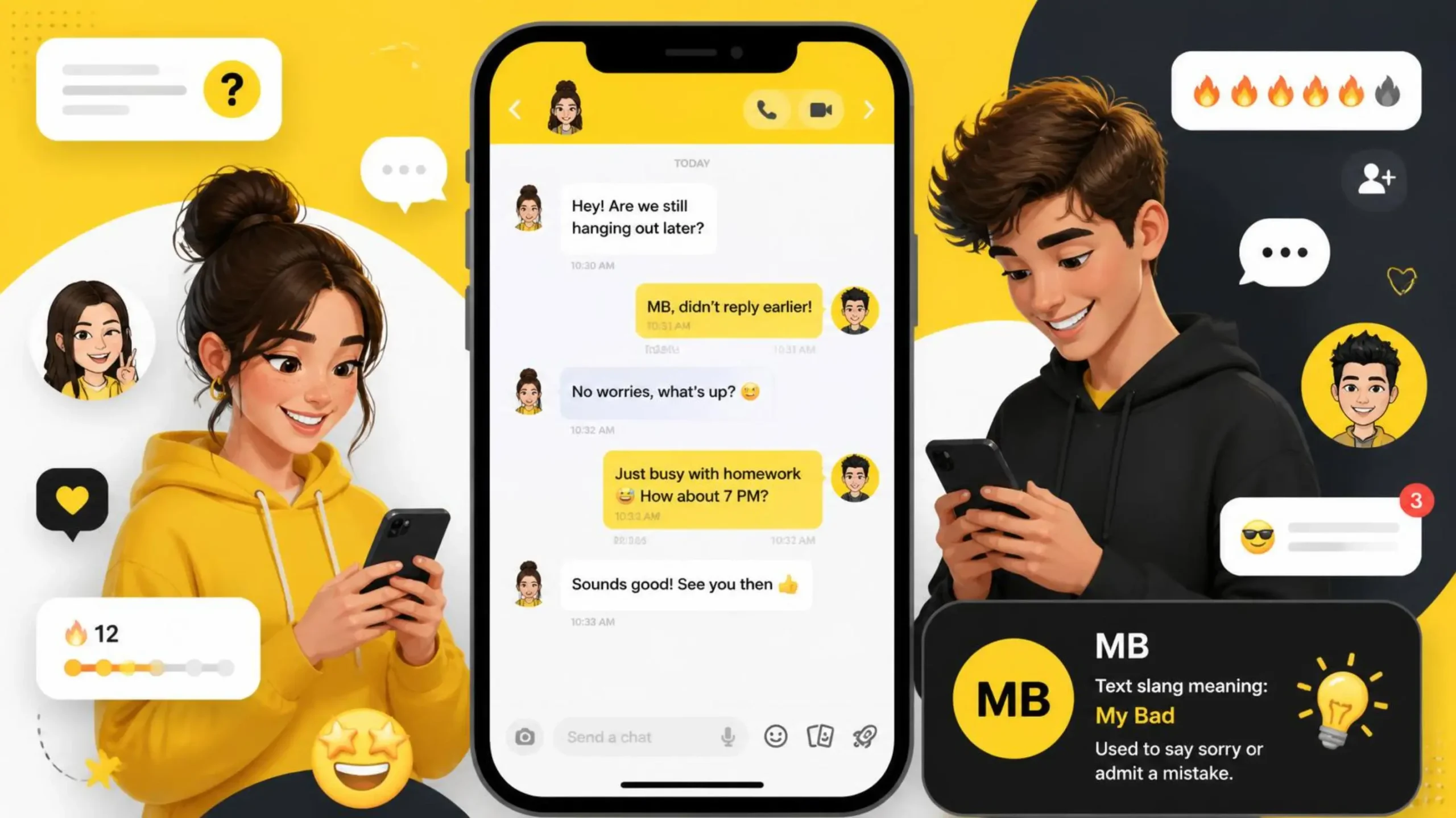
If you’ve spent any time scrolling through Snapchat, you’ve probably seen “MB” pop up in a chat and wondered what it means. This two-letter abbreviation shows up constantly in DMs, story replies, and group chats, and understanding it instantly makes Snapchat conversations easier to follow. MB stands for “My Bad” — a quick, casual way to apologize or admit a mistake. This guide breaks down the full MB Snapchat meaning, explores its origin, walks through every context where you’ll see it, and clears up common confusion around similar-looking acronyms like MBB and MBN.
Snapchat culture moves fast, and its slang moves even faster. Terms like MB didn’t originate on the app — they migrated in from texting culture and other platforms — but Snapchat’s fast-paced, disappearing-message format turned MB into a staple of everyday conversation. Whether someone left you on read, sent a blurry photo, or missed your snap, MB is the go-to way to smooth things over without typing out a full sentence.
By the end of this guide, you’ll know exactly what MB means, when people use it, how tone changes its meaning, which related terms to watch for, and how to use it yourself without sounding out of touch. Let’s decode it.
What Does MB Mean on Snapchat?
MB stands for “My Bad.” People use it as a quick apology or an acknowledgment that they made a small mistake. It functions the same way “oops” or “sorry about that” would in everyday speech, just condensed into two letters for faster typing.
You’ll typically see MB in situations like:
- Someone forgot to reply to a snap
- Someone sent a blurry, dark, or accidental photo
- Someone gave wrong information
- Someone showed up late to a planned call or hangout
- Someone accidentally sent a message to the wrong person
For example, if a friend snaps you a photo of the wrong location for a meetup, they might follow up with: “MB, wrong pin, we’re actually meeting at the other spot.”
A Secondary Meaning: “Might Be”
MB occasionally stands for “Might Be” instead. People use this version when they’re uncertain about something and want to express a soft possibility rather than a firm answer. For instance, someone might text, “MB raining later, bring a jacket just in case.”
This meaning shows up far less often than “My Bad.” Context makes the difference clear almost every time — if MB follows a mistake or mishap, it means “My Bad.” If it precedes a guess or prediction, it means “Might Be.”
Where MB Came From
MB doesn’t have a single inventor or a viral origin moment the way some slang terms do. It grew out of general texting shorthand, where users compressed everyday phrases to save keystrokes and speed up conversation. “My bad” itself has roots in casual American English and basketball culture from decades ago, where players would say “my bad” after a missed pass or a foul — a quick, informal way to own a mistake without dwelling on it.
As texting and instant messaging exploded in the 2000s and 2010s, “my bad” got compressed into “MB” the same way other common phrases became acronyms (think “TBH” for “to be honest” or “IDK” for “I don’t know”). Snapchat, along with Instagram, TikTok, and Discord, simply inherited this shorthand from broader internet and texting culture rather than creating it.
How People Use MB Across Platforms

While this guide focuses on Snapchat, MB shows up everywhere digital conversation happens. Here’s how its use compares across platforms.
MB on Snapchat
Snapchat’s format — quick photos, short captions, and disappearing messages — makes MB especially useful. People drop it into:
- Direct snaps and chats, right after a mistake
- Story replies, when reacting to something they got wrong earlier
- Group chats, to quickly own up to a mix-up without derailing the conversation
MB on Instagram
On Instagram, MB shows up most often in comments and DMs. Someone might comment “MB, didn’t realize this was already posted” under a duplicate photo, or use it in a reply thread to smooth over a miscommunication.
MB on TikTok
TikTok users tend to use MB in video captions or comment sections, often self-deprecatingly. A creator might caption a video “MB for the bad lighting” or reply to a comment pointing out an error with a simple “mb 😅.”
MB on Discord and Gaming Chats
In gaming communities, MB is extremely common after a mistake during gameplay — missing a shot, calling out the wrong direction, or accidentally friendly-firing a teammate. A player might type “mb, didn’t see you there” mid-match. Because gaming chat moves fast, MB’s brevity makes it ideal.
MB in Texting and Everyday Messaging
Outside of any specific app, MB functions the same way in regular text messages. It’s become so normalized that many people use it in place of “sorry” for minor, low-stakes mistakes.
MB in Dating Contexts
In dating app conversations or early-stage texting with a romantic interest, MB usually signals a light, low-pressure apology — for example, apologizing for a late reply without making it feel heavy or overly formal.
MB in the Workplace
MB rarely appears in professional communication. Because it’s casual slang, using it in work emails or formal Slack channels can come across as unprofessional. It occasionally appears in informal workplace chat channels among peers with an established casual rapport, but it’s not a safe default for professional settings.
Tone and Connotation: How MB Feels in Conversation
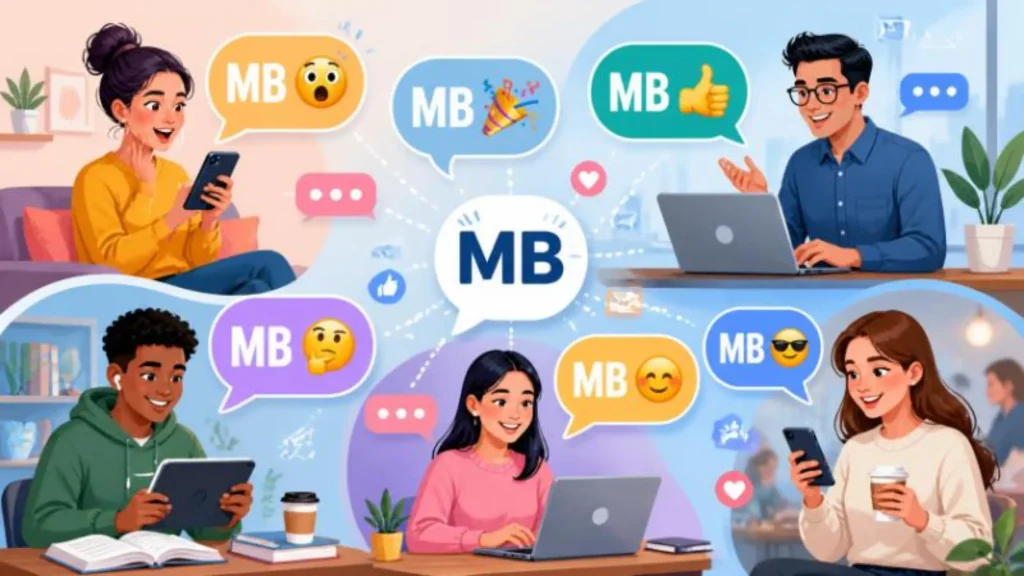
MB carries a casual, low-stakes tone. It works well for small mistakes but feels dismissive or insincere if used for something that actually hurt someone or caused real inconvenience. Tone shifts depending on context:
- Genuine and lighthearted: Used for small, harmless mistakes — a blurry photo, a late reply, a wrong guess.
- Sarcastic: Sometimes used ironically, especially among friends joking around, where the “mistake” wasn’t really a mistake at all.
- Dismissive: In some cases, people use MB to brush off a mistake without real accountability, which can come across as insincere if the issue was serious.
Because MB downplays the significance of a mistake, it’s best reserved for minor slip-ups rather than situations that call for a real apology.
Common Variations and Related Terms
Snapchat and texting slang love to riff on existing terms. Here are the most common ones related to MB:
| Term | Meaning | Notes |
| MB | “My Bad” or “Might Be” | The core term; “My Bad” is by far the more common meaning |
| MBB | “My Bad Bro” or “Maybe Baby” | Meaning depends entirely on context — apology among friends vs. flirty language in dating contexts |
| MBN | “Must Be Nice” | Usually sarcastic, expressing envy or passive-aggressive commentary |
| NP | “No Problem” | Common reply to someone saying MB |
| IMY | “I Miss You” | Unrelated meaning but frequently appears in similar casual chat contexts |
| TBH | “To Be Honest” | Another compressed acronym from the same texting-shorthand tradition |
MBB vs. MB
MBB causes the most confusion because it has two entirely different meanings depending on context:
- “My Bad Bro” — an apology, similar to MB but slightly more emphatic or masculine-coded, though used by all genders today.
- “Maybe Baby” — a flirty, affectionate phrase used in romantic or playful contexts, often accompanied by emojis or a teasing tone.
If someone sends MBB after a mistake, they mean “My Bad Bro.” If someone sends MBB during a flirty conversation with no mistake involved, they likely mean “Maybe Baby.” Reading the surrounding context resolves the ambiguity almost every time.
Realistic Conversation Examples
Seeing MB in action helps clarify exactly how people use it. Here are a few realistic scenarios:
Scenario 1: Missed a Snap
Friend: “Did you see my snap from earlier??” You: “Omg no, mb! Just saw it now lol”
Scenario 2: Wrong Information
Friend: “The party doesn’t start till 9, not 8” You: “Mb, I read it wrong”
Scenario 3: Blurry Photo
You send a dark, out-of-focus photo. You: “mb, potato camera 😂”
Scenario 4: Sarcastic Use Among Friends
Friend: “You made me miss the bus lol” You: “mb for existing 🙄”
Scenario 5: “Might Be” Usage
Friend: “Is it gonna rain this weekend?” You: “mb, forecast looked kinda unclear”
How to Use MB the Right Way
A few practical tips help you use MB naturally and avoid common mistakes:
- Match the stakes. Use MB for small mishaps, not serious issues that need a real apology.
- Read the room. Among close friends, MB can be playful or sarcastic; with people you don’t know well, keep it sincere.
- Skip it in professional contexts. Stick to full, clear language in work emails or formal messages.
- Pair it with an explanation when needed. “MB” alone sometimes feels too brief; adding a short reason (“mb, phone died”) makes the apology feel more genuine.
- Don’t overuse it. Relying on MB for every mistake, big or small, can make apologies feel hollow over time.
Common Mistakes to Avoid
- Using MB for something that genuinely upset someone — it can come across as dismissive rather than apologetic.
- Confusing MB with MBB or MBN, which carry different meanings entirely.
- Using it in formal or professional communication where it reads as unprofessional.
- Assuming everyone knows the term — older or less online audiences may not recognize it.
Why MB Has Stuck Around
Digital communication rewards brevity, and MB fits perfectly into a culture built on fast replies, disappearing messages, and low-effort social maintenance. It lets people acknowledge small mistakes without derailing a conversation or making things awkward. As long as texting and social messaging favor short, casual language, terms like MB are likely to stay in everyday use — even as new slang continues to emerge alongside it.
Quick Reference Summary
| Category | Details |
| Full meaning | “My Bad” (primary); “Might Be” (secondary) |
| Origin | Grew from general texting shorthand and older “my bad” slang |
| Common platforms | Snapchat, Instagram, TikTok, Discord, texting |
| Tone | Casual, low-stakes, sometimes sarcastic or playful |
| Popularity | Very common in casual digital conversation |
| Best used for | Minor mistakes, small mix-ups, lighthearted apologies |
| Avoid using for | Serious mistakes, formal or professional communication |
| Related terms | MBB, MBN, NP, TBH |
Frequently Asked Questions
Does MB mean the same thing on every platform?
Yes, for the most part. “My Bad” is the dominant meaning across Snapchat, Instagram, TikTok, Discord, and standard texting. The context of the conversation, not the platform, determines which meaning applies.
Is MB rude to use?
No, MB itself isn’t rude. It’s casual and lighthearted. It can come across as dismissive if used for a mistake serious enough to warrant a fuller apology, but for everyday slip-ups it reads as friendly and normal.
Can MB be used sarcastically?
Yes. Among friends, people often use MB sarcastically when joking around, especially when the “mistake” wasn’t a real mistake at all.
What’s the difference between MB and MBB?
MB means “My Bad.” MBB can mean either “My Bad Bro” (an apology) or “Maybe Baby” (a flirty phrase), depending entirely on the context of the conversation.
Is it okay to use MB with someone I just started talking to?
Yes, MB works fine in early-stage conversations, including dating contexts, as a low-pressure way to acknowledge a small mistake like a late reply.
Should I use MB in a work email?
No. MB is internet and texting slang, and using it in professional emails or formal communication typically comes across as unprofessional.
What should I reply when someone says MB to me?
Common responses include “np” (no problem), “all good,” or simply moving on with the conversation, since MB usually doesn’t require a formal acceptance of the apology.
Did MB originate on Snapchat?
No. MB predates Snapchat and comes from broader texting and internet shorthand culture. Snapchat’s fast, casual messaging style simply made it a common feature of conversations on the app.
Why do people use acronyms like MB instead of typing full words?
Acronyms like MB save time and keystrokes, which matters on fast-moving platforms where conversations happen in real time and messages are often brief by design.
Is “Might Be” or “My Bad” more common?
“My Bad” is far more common. “Might Be” appears occasionally, but context almost always makes it clear which meaning applies within seconds.
Conclusion
MB stands for “My Bad” in the vast majority of Snapchat conversations, functioning as a quick, casual apology for small mistakes — missed snaps, blurry photos, wrong information, or minor mix-ups. A secondary, less common meaning, “Might Be,” shows up when someone expresses uncertainty rather than acknowledging an error. Context makes the intended meaning clear almost instantly.
Understanding MB — along with related terms like MBB and MBN — helps you read Snapchat conversations accurately and respond naturally. Use it for lighthearted, low-stakes situations, skip it in professional settings, and pay attention to tone so you never mistake a sarcastic MB for a sincere one. With that, you’re fully equipped to navigate this small but mighty piece of Snapchat slang.

Basra Kamal is a content writer and researcher at Top Meaning, specializing in word meanings, abbreviations, internet slang, texting terms, and modern language trends. She is passionate about making complex words and online expressions easy to understand through clear, accurate, and well-researched content. Her work helps readers quickly find reliable explanations of popular terms, phrases, and acronyms used in everyday communication and digital culture.




1 thought on “MB Snapchat Meaning: The Complete Guide to This Popular Slang Term”