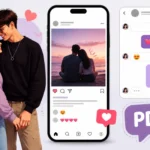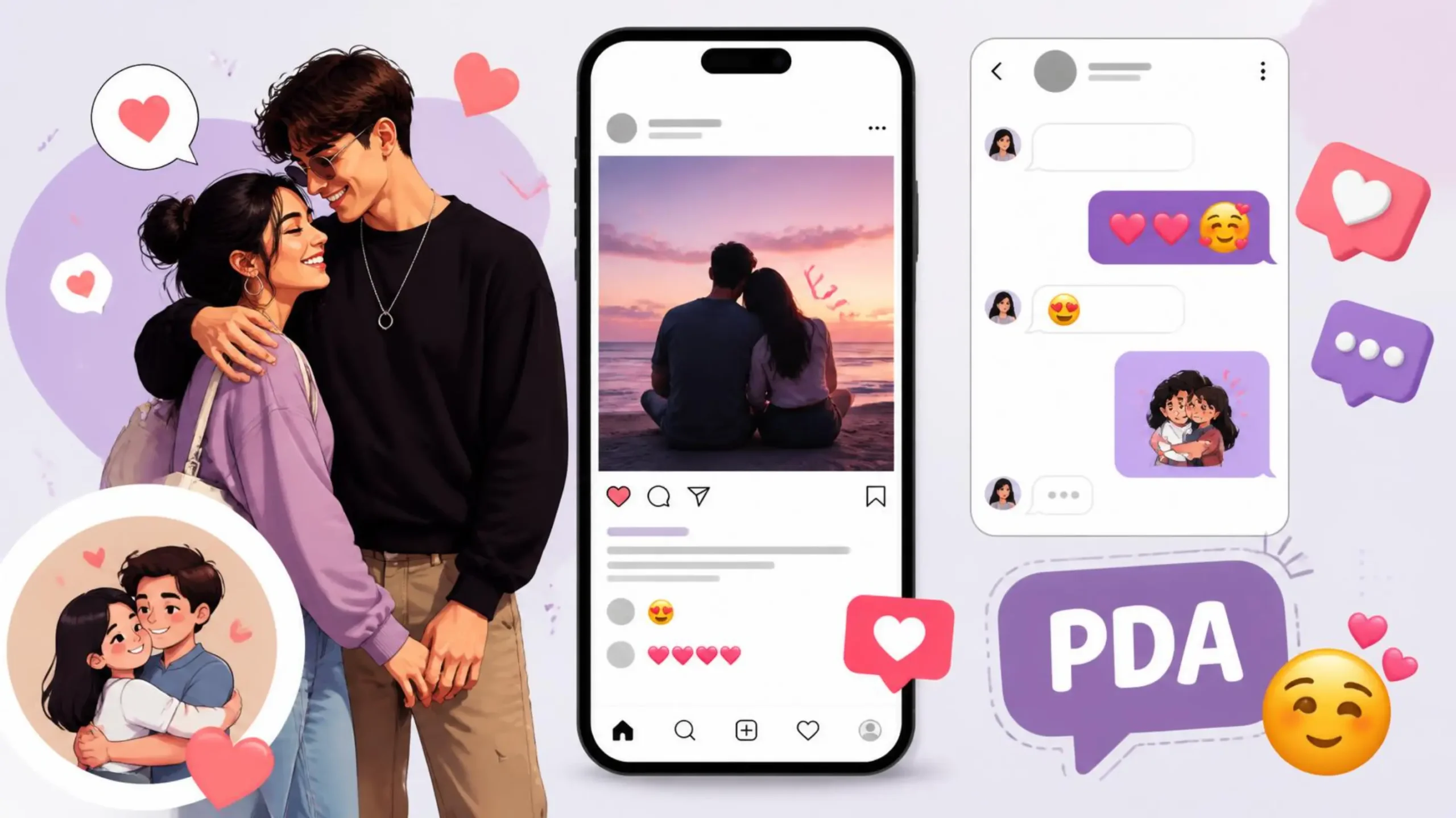
If you’ve scrolled through Instagram and come across couples sharing hugs, kisses, or affectionate captions with the tag “PDA,” you’ve probably wondered what the term actually means. PDA stands for “Public Display of Affection” — physical or verbal expressions of romantic affection shared openly, whether in person or, increasingly, online through photos, captions, and stories. This guide breaks down the full PDA meaning on Instagram, explains where the term came from, and explores how it shows up across captions, comments, reels, and stories.
Instagram has become one of the biggest stages for couples to share their relationships with the world, and PDA culture has evolved right alongside it. What used to mean holding hands in public now includes couple photo dumps, matching captions, tagged locations, and affectionate comment exchanges — all visible to hundreds or thousands of followers. Understanding PDA helps you make sense of relationship content on your feed, use the term correctly yourself, and recognize the difference between genuine affection and performative “relationship goals” posting.
By the end of this guide, you’ll understand exactly what PDA means, how it plays out across Instagram and other platforms, why it generates so much conversation, and how tone and context shape whether it reads as sweet or excessive. Let’s break it down.
What Does PDA Mean on Instagram?
PDA stands for “Public Display of Affection.” It describes any visible expression of romantic affection — hugging, kissing, holding hands, or affectionate language — shared in a setting others can see. On Instagram specifically, PDA refers to couples posting photos, videos, or captions that showcase their romantic relationship publicly, where followers, friends, and sometimes strangers can view it.
Common examples of PDA on Instagram include:
- A couple posting a kissing photo with the caption “PDA alert 😘”
- A boyfriend or girlfriend commenting something affectionate on their partner’s post
- A couple sharing a photo dump that includes hand-holding or cuddling shots
- Instagram Stories showing a couple cuddling, dancing, or being physically affectionate
- Captions that openly express love or attraction toward a partner
For example, someone might post a beach photo with their partner and caption it: “Warning: PDA incoming 🌊❤️” — signaling to followers that the post leans into romantic, affectionate content.
PDA as a Broader Term Beyond Instagram
While this guide focuses on Instagram, PDA existed as a phrase long before social media. It originally described real-world affection shown in public spaces — a couple kissing at a train station, holding hands while walking, or hugging at a restaurant. Social media essentially extended the concept of “public” from physical spaces to digital ones, where an Instagram feed functions as its own kind of public square.
Where the Term PDA Came From
“Public Display of Affection” has been part of everyday English for decades, long predating the internet. The phrase gained cultural traction as a way to describe — and sometimes politely criticize — couples who showed physical affection in public settings like schools, workplaces, or restaurants. Many people grew up hearing phrases like “get a room” directed at couples engaging in noticeable PDA.
As social media matured, particularly platforms built around photos and videos like Instagram, the concept expanded naturally. Posting a couple photo, tagging a partner, or writing an affectionate caption became a digital equivalent of holding hands in public — visible, intentional, and meant to be seen by an audience. The acronym PDA carried over directly into caption culture, hashtags, and comment sections without needing to be reinvented.
How PDA Shows Up Across Platforms
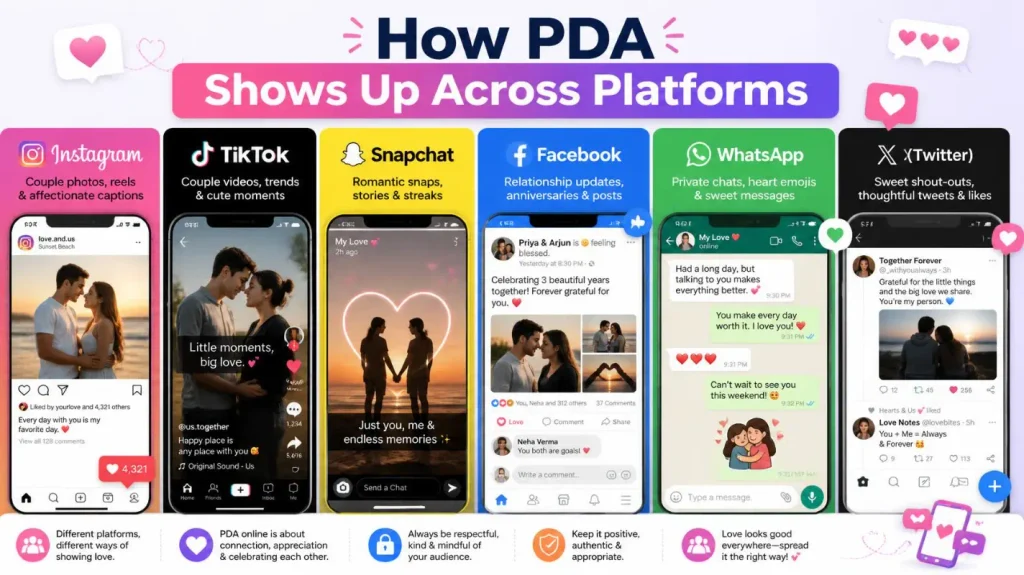
Although PDA is closely associated with Instagram, the concept and the term itself appear across nearly every major social platform.
PDA on Instagram
Instagram remains the platform most associated with PDA due to its photo-and-video-first format. Common places you’ll see it include:
- Feed posts: Couple photos, anniversary posts, or “day in the life” content featuring a partner
- Captions: Phrases like “PDA szn” or “excuse the PDA” used self-aware, often humorously
- Stories: Short clips of couples being affectionate, often paired with music or stickers
- Reels: Trending audio paired with affectionate couple content
- Comments: Partners leaving flirty or affectionate comments on each other’s posts, visible to all followers
PDA on TikTok
TikTok hosts a huge volume of couple content, and PDA-related trends move quickly there. Couples often participate in “PDA challenges,” reacting to prompts or trending sounds by showing affection on camera.
PDA on Snapchat
Because Snapchat leans more private and ephemeral, PDA content tends to appear in couple-specific Snapchat stories rather than broad public posts, though it’s less central to Snapchat culture than to Instagram or TikTok.
PDA on Reddit
Reddit discussions about PDA tend to be more analytical or opinion-based rather than showcasing it directly. Threads often debate whether certain public affection — online or offline — crosses a line into “too much,” especially in subreddits focused on relationships or etiquette.
PDA in Text Messages and Everyday Conversation
Outside of any platform, people use PDA conversationally to describe real-life affection. Someone might text a friend, “They were being so PDA at the restaurant,” to describe a couple being visibly affectionate in person.
PDA in Dating Contexts
In the context of dating and relationships, PDA often comes up as a compatibility topic. Some people love showing affection publicly and posting their relationship online; others prefer keeping their relationship more private. This difference frequently becomes a talking point early in relationships.
PDA in the Workplace
PDA rarely applies directly to workplace social media use, but the underlying concept matters in professional settings — visible affection between coworkers in a relationship is generally considered inappropriate for the workplace, mirroring the same social norms that shape online PDA etiquette.
Tone and Connotation: How PDA Reads in Different Contexts
PDA can carry very different tones depending on how it’s used and who’s viewing it.
- Sweet and genuine: Many people view tasteful PDA posts — a hand-hold, a hug, a heartfelt caption — as wholesome relationship content.
- Excessive or performative: When PDA becomes frequent, exaggerated, or seems aimed at proving a relationship’s status rather than expressing real affection, it can come across as “trying too hard” or performative.
- Playfully self-aware: Many Instagram users caption their own PDA content with humor, acknowledging it upfront (“sorry not sorry for the PDA”) to soften any perceived excess.
- Mildly criticized: Some audiences find heavy PDA content annoying or oversharing, especially when it dominates someone’s entire feed.
Because Instagram is a curated, public-facing platform, PDA content often walks a line between authentic connection and performance for an audience — and how it’s received depends heavily on how genuine and proportionate it feels.
Common Variations and Related Terms
| Term | Meaning | Notes |
| PDA | “Public Display of Affection” | The core meaning across nearly all social platforms |
| PDA szn | “PDA season” | Playful phrase used in captions, especially around Valentine’s Day or anniversaries |
| Relationship goals | Aspirational couple content | Often paired with PDA posts to signal an “ideal” relationship |
| Soft launch | Subtly introducing a partner online | Often precedes more overt PDA posting once a couple goes public |
| Hard launch | Fully and openly announcing a relationship | Frequently includes a PDA-heavy post as the announcement |
| Couple goals | Similar to “relationship goals” | Frequently used interchangeably in comment sections |
Soft Launch vs. Hard Launch vs. PDA
These three terms often appear together in relationship-related Instagram culture:
- Soft launch — Hinting at a relationship without fully revealing the partner (a hand in a photo, a mysterious tag).
- Hard launch — Fully revealing the relationship, often through a clear couple photo.
- PDA — The ongoing affectionate content that typically follows a hard launch, showing the relationship openly and repeatedly.
Understanding this progression helps explain why PDA posts often appear in waves — a hard launch usually kicks off a period of more visible PDA content as a couple becomes comfortable sharing their relationship.
Realistic Examples of PDA on Instagram
Seeing PDA in action clarifies how people actually use the term:
Scenario 1: Anniversary Post
Caption: “3 years with my favorite person 🥹❤️ (mind the PDA)”
Scenario 2: Self-Aware Caption
Caption: “Okay one more PDA post I promise 😂”
Scenario 3: Comment Exchange
Partner’s comment: “Cutest human alive 😍” Reply: “Stoppp the PDA 😭 (but I love you)”
Scenario 4: Friend Reacting to a Couple’s Feed
“Their whole page is just PDA at this point lol”
Scenario 5: Conversational Use Offline
“They were being so PDA at dinner, I had to look away.”
How to Use PDA Appropriately
A few tips help you use the term naturally, whether describing your own relationship content or someone else’s:
- Use it descriptively, not judgmentally, unless you’re intentionally being playful or joking with someone who won’t mind.
- Match the platform’s culture. Instagram tends to embrace tasteful PDA; more private platforms may not be the place for it.
- Read the room in the comments. Teasing a friend about PDA is common, but tone matters — keep it lighthearted rather than mocking.
- Consider your audience before posting heavy PDA content, especially on professional or public-facing accounts.
- Balance authenticity with restraint. The most well-received PDA content tends to feel genuine rather than performative.
Common Mistakes to Avoid
- Confusing PDA with unrelated acronyms (PDA also stands for “personal digital assistant” or, in medical contexts, “patent ductus arteriosus” — context always makes the intended meaning clear).
- Assuming all PDA content is negative — most of it is simply normal relationship sharing.
- Overusing PDA content to the point that it overwhelms an otherwise varied feed, which can reduce engagement from followers less interested in couple content.
- Using PDA-heavy captions in professional or brand-related posts, where it can feel out of place.
Why PDA Culture Has Grown on Instagram
Instagram’s visual, caption-driven format naturally invites relationship sharing, and cultural shifts around openly discussing relationships online have made PDA content increasingly normal. Younger generations especially treat sharing a relationship publicly as a natural extension of being in one, rather than something to keep separate from social media. As long as Instagram remains built around photos, captions, and personal storytelling, PDA content will likely remain a fixture of couple culture on the platform.
Quick Reference Summary
| Category | Details |
| Full meaning | “Public Display of Affection” |
| Origin | Predates social media; describes affection shown in public settings |
| Common platforms | Instagram, TikTok, Snapchat, everyday conversation |
| Tone | Ranges from sweet and genuine to performative or excessive |
| Popularity | Extremely common in couple-related social media content |
| Best used for | Describing visible romantic affection, online or in person |
| Related terms | Soft launch, hard launch, relationship goals, couple goals |
Frequently Asked Questions
Does PDA only apply to romantic couples?
Yes, in nearly all contexts, PDA specifically refers to romantic affection rather than platonic or familial affection.
Is PDA a negative term?
Not inherently. PDA is a neutral, descriptive term. Whether it reads positively or negatively depends on the amount, context, and how genuine it feels to viewers.
What’s the difference between a hard launch and PDA?
A hard launch is the moment a couple publicly reveals their relationship. PDA refers to the ongoing affectionate content that typically continues afterward.
Why do people caption their posts “PDA warning” or “excuse the PDA”?
It’s a playful, self-aware way of acknowledging that the post is more affectionate than usual, often used to soften potential teasing from followers.
Does PDA mean something different outside of relationships?
Yes. Outside of relationship contexts, PDA can also stand for “personal digital assistant” (an older term for handheld electronic organizers) or, in medical settings, “patent ductus arteriosus.” Context makes the intended meaning obvious.
Is too much PDA on Instagram considered bad etiquette?
Opinions vary. Some followers enjoy relationship content, while others find excessive PDA posting repetitive or performative. There’s no universal rule, but balance tends to be well received.
Do celebrities use PDA the same way as everyday users?
Yes, though celebrity PDA often receives more public attention and media coverage due to their larger, more engaged audiences.
Is PDA more common among younger social media users?
Generally, yes. Younger generations tend to share relationship content more openly, partly because platforms like Instagram and TikTok are deeply integrated into how they document daily life.
Can PDA apply to Instagram Stories as well as feed posts?
Absolutely. Stories are actually one of the most common places for PDA content, since they feel more casual and temporary than permanent feed posts.
What should I do if I don’t want to see PDA content on my feed?
Instagram allows you to mute or unfollow accounts that post content you’d rather not see, without unfriending or blocking the person.
Conclusion
PDA stands for “Public Display of Affection” and describes the visible, often photographed or captioned expressions of romantic affection that couples share on Instagram and beyond. From soft launches to hard launches to ongoing PDA content, the term captures a natural part of modern relationship culture — one shaped heavily by how visual and caption-driven platforms like Instagram have changed the way couples share their lives.
Whether you’re posting your own relationship content, scrolling past someone else’s, or simply trying to understand a caption you came across, knowing what PDA means helps you navigate Instagram’s relationship culture with confidence. Keep it genuine, read the room, and you’ll use the term — and the concept — exactly the way it’s meant to be used.

Basra Kamal is a content writer and researcher at Top Meaning, specializing in word meanings, abbreviations, internet slang, texting terms, and modern language trends. She is passionate about making complex words and online expressions easy to understand through clear, accurate, and well-researched content. Her work helps readers quickly find reliable explanations of popular terms, phrases, and acronyms used in everyday communication and digital culture.