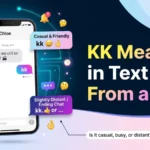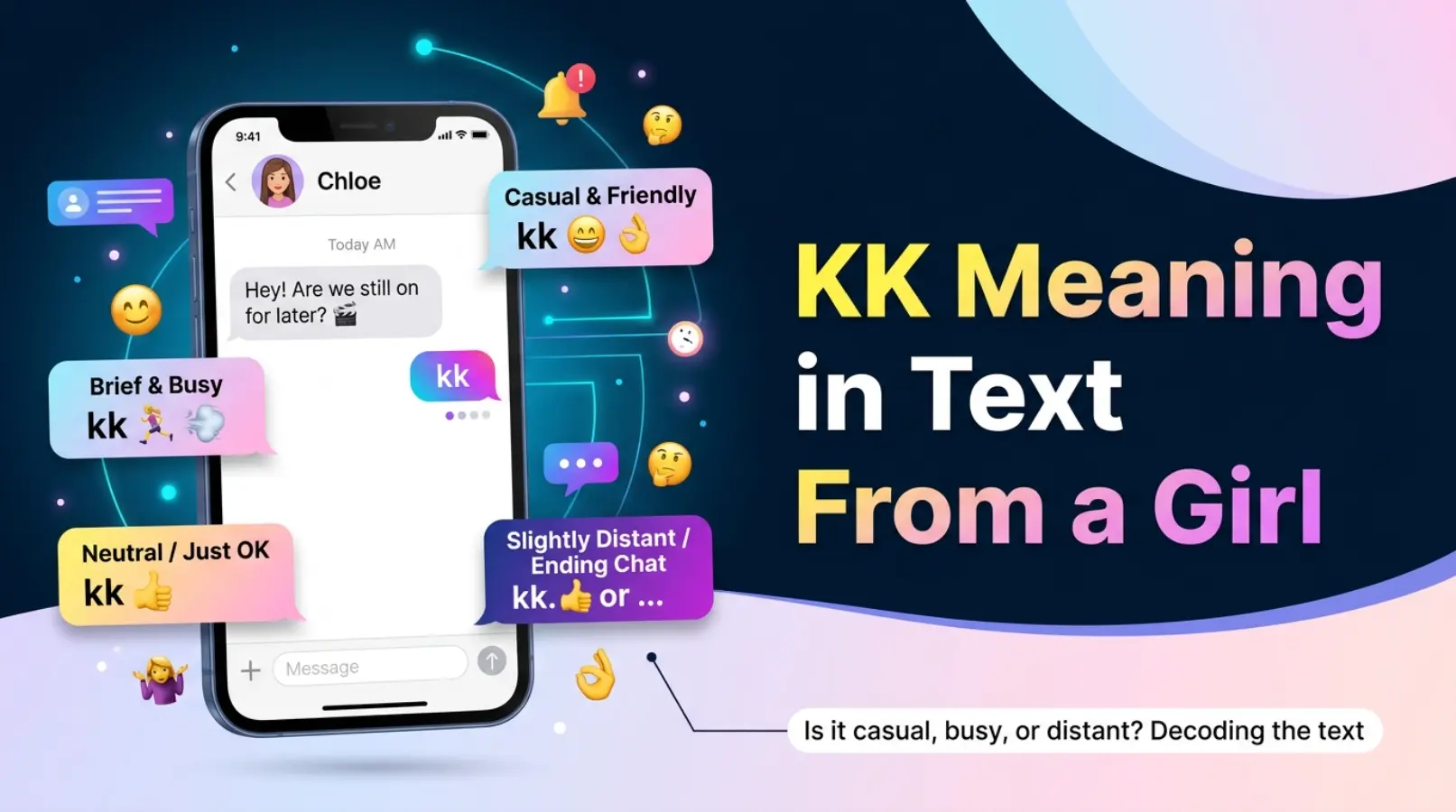
“Kk” just landed in your texts, and now you’re staring at your phone wondering what it actually means. Is she annoyed? Bored? Totally fine? You’re not alone — kk meaning in text from a girl is one of the most searched texting mysteries out there, and for good reason: two tiny letters can carry a dozen different emotional undertones depending on who sent them, when, and what came before.
At its core, “kk” is simply a shorthand way of saying “okay, okay” — a casual, friendly acknowledgment that confirms she’s received your message and is fine with whatever you said. It’s part of a much larger family of texting abbreviations like “k,” “kk,” “okie,” and “aight” that have evolved alongside modern digital communication on iMessage, WhatsApp, Snapchat, Instagram DMs, and Discord.
But here’s the catch: context is everything. The same two letters can mean genuine agreement, mild dismissal, playful energy, or — in rare cases — quiet frustration. In this guide, you’ll learn exactly what kk means across different platforms and relationships, how it differs from the more famous (and often dreaded) single-letter “k,” and how to respond so you never second-guess a text again.
What Does “Kk” Mean in a Text?
“Kk” is internet and texting shorthand for “okay, okay” or simply an emphasized, friendlier version of “okay.” It’s used to confirm, acknowledge, or agree with something someone just said, and it’s one of the most common acknowledgment texts in casual digital conversation.
Unlike the single letter “k” — which is widely perceived as blunt, cold, or even passive-aggressive — “kk” almost always reads as warmer and more casual. The doubling of the letter softens the tone, making it feel more like a nod and a smile rather than a curt dismissal.
Quick Definition
Kk (informal, texting slang): A short, casual way of saying “okay” or “alright,” typically used to acknowledge a message, confirm plans, or signal easy agreement without needing further explanation.
Where Did “Kk” Come From? Origin and History
Like most texting slang, “kk” didn’t originate from a single dramatic moment — it evolved naturally out of necessity and convenience.
- Early internet chat rooms (late 1990s–2000s): Platforms like AIM (AOL Instant Messenger), MSN Messenger, and early IRC chats popularized short, quick-typed responses. Typing “okay” felt slow when a conversation was moving fast, so users shortened it to “k.”
- The rise of “k” as a standalone response: Over time, “k” alone started to carry negative connotations — it read as short, dismissive, or annoyed, especially in text conversations where tone is already hard to read.
- “Kk” as the friendlier alternative: To avoid the cold, clipped feeling of a single “k,” people began doubling the letter. The repetition mimics a verbal double affirmation, similar to saying “okay, okay!” out loud — think of a friend nodding twice instead of once.
- Mobile texting and smartphone era (2007–present): With the explosion of SMS, then iMessage, WhatsApp, and social media DMs, “kk” became a staple of fast, low-effort, friendly communication, especially among teens, young adults, and casual daters.
Today, “kk” is deeply embedded in everyday digital communication, gaming chat, group texts, and social apps, and it shows no signs of disappearing.
“Kk” vs. “K”: Why One Letter Makes a Huge Difference
This is where most of the confusion around kk meaning in text from a girl actually comes from — people often mix up “k” and “kk,” but they carry very different emotional weight.
| Term | Common Tone | Typical Feeling It Gives | Best Used For |
| K | Blunt, curt, sometimes cold | Can feel dismissive or annoyed | Rarely a good choice in emotionally important texts |
| Kk | Friendly, casual, relaxed | Comes across as easygoing and warm | Everyday confirmations, casual plans, light agreement |
| Okay | Neutral, standard | Straightforward, no strong emotion either way | Formal or semi-formal texts |
| Okie / Okie dokie | Playful, bubbly | Feels cute, upbeat, affectionate | Flirty or close friend conversations |
| Alright / Aight | Casual, chill | Laid-back, low-key agreement | Casual conversations, scheduling |
The key takeaway: if a girl texts “kk” instead of just “k,” she’s almost always being friendly, not cold. The extra letter softens what could otherwise feel like a short, dismissive reply.
What Does It Mean When a Girl Texts You “Kk”? (Ranked by Popularity)
Since texting tone depends heavily on context, here are the most common meanings behind “kk” from a girl, ranked from most to least likely.
1. Simple, Friendly Agreement (Most Common)
In the vast majority of cases, “kk” simply means “got it, sounds good.” She’s confirming plans, acknowledging information, or agreeing to something you said — nothing more, nothing less.
Example:
You: “I’ll pick you up at 7!” Her: “Kk see you then 😊”
This is a textbook example of casual confirmation texting — relaxed, positive, and low-stress.
2. Quick Acknowledgment (No Strong Emotion Attached)
Sometimes “kk” is purely functional. She’s busy, multitasking, or just letting you know she saw your message without needing to elaborate.
Example:
You: “Running 10 minutes late!” Her: “Kk no worries”
Here, “kk” functions like a digital head-nod — she processed the info and moved on.
3. Playful or Flirty Energy
In flirtier conversations, especially early dating or texting a crush, “kk” paired with emojis, exclamation points, or fast replies often signals enthusiasm and comfort.
Example:
You: “Movie night Friday? 🍿” Her: “Kkkk yes!! Can’t wait”
Notice the extra “k’s” — stretching “kk” into “kkk” or “kkkk” is a common Gen Z texting habit that amplifies excitement rather than reducing it.
4. Polite but Slightly Disengaged
Occasionally, “kk” can signal that she’s not particularly invested in the conversation at that moment — not necessarily upset, just mentally elsewhere.
Signs this might be the case:
- The reply comes with no emojis, punctuation, or follow-up questions
- Responses have become shorter over the conversation
- There’s a noticeable delay before she replies
This doesn’t automatically mean something is wrong — it could simply mean she’s busy, tired, or distracted.
5. Mild Annoyance or Wanting to End the Conversation (Least Common, Context-Dependent)
Rarely, “kk” can carry a hint of “let’s drop this” energy, particularly if it follows an argument, a heavy topic, or repeated unanswered questions.
Example:
You: “Can we talk about what happened yesterday?” Her: “Kk.”
In this context, the short, punctuation-free “Kk.” (especially with a period) can feel more closed-off than the usual upbeat version.
How to Read the Real Meaning: Context Clues That Matter
Since “kk” meaning in a text from a girl shifts based on situation, here’s how to accurately interpret it every time.
1. Look at Punctuation
- “Kk!” or “Kk 😊” → Warm, positive, enthusiastic
- “Kk” (no punctuation) → Neutral, casual
- “Kk.” (with a period) → Can feel more final, sometimes flat or slightly annoyed
2. Check Response Speed
A fast “kk” usually signals ease and comfort. A “kk” that comes after a long delay may simply reflect her schedule — not her feelings.
3. Notice the Conversation History
If the texts before it were playful and engaged, “kk” continues that tone. If the conversation had tension, “kk” may reflect that tension too.
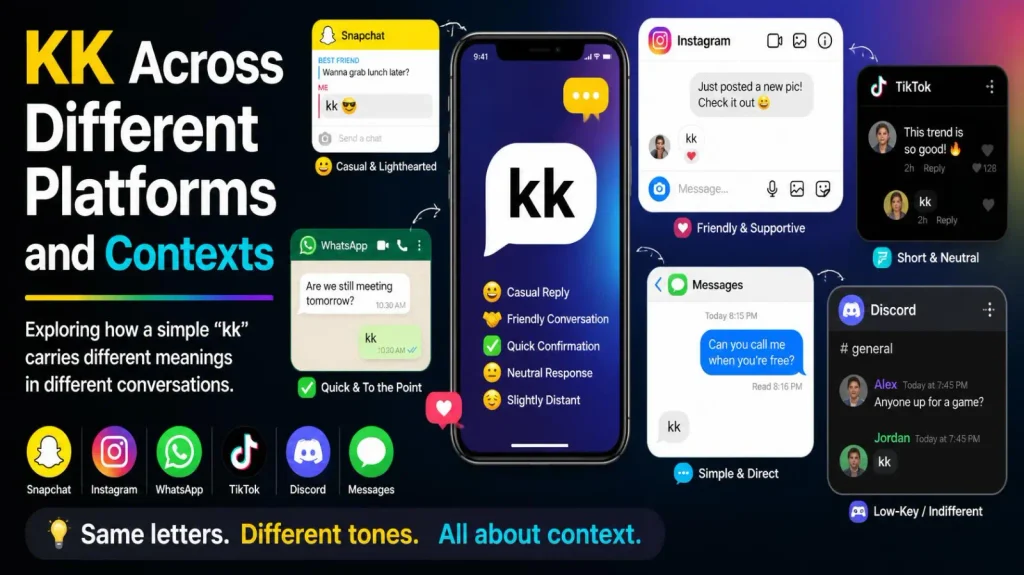
4. Consider the Platform
- iMessage/SMS: Often used for logistics and plans — usually neutral-to-friendly
- Snapchat/Instagram DMs: More casual, often paired with emojis or stickers
- Discord/Gaming chats: Quick, functional, rarely emotionally loaded
- Dating apps: Tone matters more here, since first impressions are still forming
“Kk” in Different Contexts and Platforms
In Dating and Texting a Crush
When you’re texting a girl you like, “kk” is generally a green flag — it shows she’s comfortable enough to keep things casual and low-pressure with you. Overanalyzing a friendly “kk” is one of the most common texting anxiety traps people fall into.
In Friendships
Among friends, “kk” is practically punctuation at this point. It rarely carries deep meaning and is mostly used to keep conversations moving efficiently.
In Group Chats
“Kk” in group settings usually just means she’s read the message and agrees or acknowledges it — group chat tone tends to be less personal by nature.
In the Workplace
While less common professionally, some younger coworkers use “kk” in casual internal chats (like Slack or Teams). In workplace settings, it generally means “understood, no issues” — but it’s best reserved for informal, non-client-facing communication.
On Social Media (TikTok, Instagram, Reddit)
On platforms like TikTok comments, Instagram captions, or Reddit threads, “kk” is often used more expressively — sometimes stretched (“kkkk”) to convey laughter-adjacent agreement or amusement, similar to how “lol” has evolved beyond literal laughing.
Common Misconceptions About “Kk”
- Misconception #1: “Kk” always means she’s upset. Reality: This is rarely true. Tone should be judged by the full conversation, not two letters alone.
- Misconception #2: “Kk” is the same as “k.” Reality: They’re different in tone — “k” tends to feel colder, while “kk” feels friendlier.
- Misconception #3: A short “kk” means she’s losing interest. Reality: Texting length naturally varies based on mood, time, and what’s being discussed — it’s not a reliable indicator on its own.
Common Mistakes People Make When Interpreting “Kk”
- Overanalyzing a single text instead of looking at the full conversation pattern.
- Ignoring punctuation and emojis, which often carry more emotional weight than the word itself.
- Assuming “kk” and “k” mean the same thing, when their tones are meaningfully different.
- Reading into response time without considering she may simply be busy.
- Not asking directly when something feels off, instead of guessing based on shorthand text.
How to Respond to “Kk” in a Text
If you’re unsure how to reply, here are a few natural options depending on the vibe:
- Casual continuation: “Kk sounds good, talk soon!”
- Keep the conversation going: “Kk! By the way, did you see that thing I sent earlier?”
- Match her energy: If she sent “Kkkk 😂,” respond with similar enthusiasm rather than a flat “ok.”
- If something feels off: “Hey, everything good? You seem a little quiet today” — a direct, low-pressure check-in works better than guessing.
Related Terms and Similar Texting Slang
- K – Shorter, often perceived as blunt or cold
- Okie / Okie dokie – Playful, upbeat version of “okay”
- Aight – Casual, laid-back agreement
- Sounds good – Neutral, slightly more formal confirmation
- Bet – Slang for agreement, popular in casual and Gen Z conversations
- Fr (“for real”) – Used to emphasize agreement or sincerity
- Lol / Lmao – Often used alongside “kk” to soften tone further
Summary Table: Kk Meaning at a Glance
| Category | Details |
| Meaning | Casual short form of “okay, okay”; confirms or acknowledges a message |
| Origin | Evolved from internet chat culture (AIM, MSN) as a friendlier alternative to “k” |
| Common Usage | Texting, DMs, group chats, gaming chats, casual dating conversations |
| Tone | Generally warm, casual, and low-pressure |
| Popularity | Extremely common, especially among teens and young adults |
| Negative Version | “K” alone, or “Kk.” with a period in tense conversations |
| Positive Version | “Kk!”, “Kkkk”, or “Kk 😊” |
| Best Response | Match her tone — casual for casual, warm for warm |
Frequently Asked Questions About “Kk” in Texting
1. Does “kk” mean a girl is mad at you?
Not usually. “Kk” is typically neutral-to-friendly. If she seems upset, look at the full conversation, punctuation, and prior messages rather than judging based on “kk” alone.
2. Is “kk” flirty?
It can be, depending on context. Paired with emojis, exclamation points, or quick replies, “kk” often signals comfort and enthusiasm, especially in early dating conversations.
3. What’s the difference between “kk” and “k” from a girl?
“K” alone tends to feel more blunt or dismissive, while “kk” generally feels warmer and more casual. The extra letter softens the tone significantly.
4. Why do some people text “kkkk” instead of “kk”?
Stretching “kk” into “kkkk” is a common way to add enthusiasm or emphasis, similar to how “yesss” adds excitement compared to a plain “yes.”
5. Should I be worried if she just replies “kk” to a long message?
Not necessarily. Short replies can simply mean she’s busy, agrees without needing to add more, or is multitasking — it’s not automatically a bad sign.
6. Is “kk” appropriate to use in professional texting?
Generally, no — “kk” is best kept for casual, informal conversations. In professional settings, “okay” or “understood” reads as more polished.
7. What does it mean if she replies “kk.” with a period?
A period can make a short reply feel more final or slightly flat, especially after a serious or emotional topic. It’s worth paying attention to context rather than assuming the worst.
8. Is “kk” more common with certain age groups?
Yes — it’s especially popular among teens, college students, and young adults who grew up texting and messaging on smartphones and social apps.
9. How can I tell if “kk” means she’s losing interest?
Look for patterns over time: consistently shorter replies, longer response gaps, and fewer questions back to you are stronger indicators than a single “kk” text.
10. What should I text back after someone sends “kk”?
A simple continuation like “Sounds good!” or a follow-up question keeps the conversation natural. If her energy was upbeat, match it; if it was brief, a light, easygoing reply works best.
Conclusion
At the end of the day, understanding kk meaning in text from a girl comes down to one core idea: it’s almost always a casual, friendly acknowledgment — not a hidden signal of anger or disinterest. The real meaning lives in the details surrounding it: punctuation, emojis, response speed, and the tone of the overall conversation.
Instead of overanalyzing two letters, focus on the bigger picture. If she’s engaged, asking questions, and replying with enthusiasm elsewhere in the conversation, a simple “kk” is just efficient, comfortable communication — nothing to worry about. And if something genuinely feels off, the best move isn’t decoding texting slang; it’s simply asking her directly.
Texting shorthand like “kk” exists to make communication faster and easier, not more complicated. Once you understand the context clues, you’ll never have to second-guess a two-letter text again.

Basra Kamal is a content writer and researcher at Top Meaning, specializing in word meanings, abbreviations, internet slang, texting terms, and modern language trends. She is passionate about making complex words and online expressions easy to understand through clear, accurate, and well-researched content. Her work helps readers quickly find reliable explanations of popular terms, phrases, and acronyms used in everyday communication and digital culture.