If you’ve come across GOMD in a text message, a tweet, a rap lyric, or a comment section and wondered what it actually stands for, you’re dealing with one of the more direct pieces of internet and hip-hop slang out there. Unlike softer abbreviations that need a little context clue-hunting, GOMD has one dominant, well-documented meaning — and it’s blunt.
GOMD stands for “Get Off My Dick.” It’s a crude, confrontational slang phrase used to tell someone to stop bothering you, back off, mind their own business, or quit criticizing you. Functionally, it means the same thing as “get off my back,” “leave me alone,” or “mind your business” — just delivered with a lot more edge.
This term didn’t emerge in a vacuum. It gained major mainstream visibility thanks to J. Cole’s 2014 song “G.O.M.D.,” which pushed the phrase (and its acronym) into much wider use across social media, hip-hop culture, and everyday texting.
This guide breaks down the full GOMD definition, traces where it came from, shows how people use it across platforms like Twitter/X, Instagram, and Reddit, explains what tone it carries, covers common variations and related slang, and — importantly — flags when you should absolutely avoid using it. By the end, you’ll understand exactly what this term means, why it exists, and how to navigate it appropriately.
Quick Answer: GOMD Definition
For anyone who just needs the fast, direct answer:
GOMD stands for “Get Off My Dick,” a vulgar slang expression meaning “stop bothering me,” “get off my back,” or “mind your own business.” People typically use it to shut down criticism, nagging, or unwanted attention, and it carries an aggressive, dismissive tone. Rapper J. Cole popularized the term with his 2014 song “G.O.M.D.”
Because the phrase embeds explicit language, people consider GOMD NSFW (not safe for work) and use it almost exclusively in casual, informal settings among peer
Where Does GOMD Come From? Origin and History
Roots in Hip-Hop and Street Vernacular
The full phrase “get off my dick” predates the acronym itself by decades. It’s part of a broader category of blunt, body-referencing insults and dismissals common in American street vernacular and hip-hop lyricism — a tradition that includes phrases like “get off my back,” “get out of my face,” and other confrontational expressions meant to assert boundaries or shut down unwanted attention.
The phrase centers on an idea of possessiveness over personal space and autonomy: the speaker tells someone, in the most emphatic terms possible, to stop hovering, criticizing, or interfering.
J. Cole’s “G.O.M.D.” (2014)
The single biggest catalyst for GOMD entering mainstream slang was rapper J. Cole’s 2014 track “G.O.M.D.,” released as part of his album 2014 Forest Hills Drive. The song’s hook repeats the phrase prominently, and its popularity — combined with a striking, historically-themed music video — helped cement the acronym in pop culture.
Following the song’s release, usage of the hashtag #GOMD spiked significantly across Twitter and other social platforms, with people adopting it as a quick, punchy way to express frustration or push back against critics, haters, or unwanted opinions.
From Song Lyric to Everyday Slang
Once a phrase like this gets embedded in a hit song, it tends to follow a predictable path:
- It appears in the song and gains recognition through radio play and streaming.
- Fans start quoting the lyric in captions, tweets, and comments.
- The phrase gets shortened into an acronym for faster typing.
- The acronym eventually detaches somewhat from the original song and becomes general-purpose slang.
GOMD followed this exact trajectory, and more than a decade later, it’s still recognizable slang, even to people who’ve never heard the original track.
What Does GOMD Mean? Breaking Down the Definition
At its core, GOMD communicates one central idea: “stop involving yourself in my business.” Depending on the situation, that can translate to a few slightly different practical meanings:
- “Leave me alone.” Used when someone is being nagged, pestered, or repeatedly contacted by someone they don’t want to deal with.
- “Mind your own business.” Used when someone is offering unsolicited opinions, judgment, or criticism about your life, choices, or actions.
- “Stop hating.” Used specifically toward critics or “haters” who seem overly invested in putting someone down.
- “Back off.” Used in a more general confrontational sense, similar to telling someone to give you space.
In every case, the emotional charge behind GOMD is the same: frustration or irritation at someone overstepping a boundary, paired with a firm, unapologetic push-back.
Summary Table: GOMD Key Facts
| Feature | Details |
| Full meaning | “Get Off My Dick” |
| Core definition | Stop bothering me / mind your own business / back off |
| Origin | Long-standing street/hip-hop vernacular; popularized by J. Cole’s 2014 song “G.O.M.D.” |
| Tone | Blunt, confrontational, dismissive, sometimes humorous |
| Popularity peak | Late 2014–2015, following the song’s release; still recognized today |
| Appropriate settings | Casual conversations among peers, social media, memes |
| Inappropriate settings | Workplace, formal writing, conversations with strangers, family, or authority figures |
| NSFW status | Yes — contains explicit language |
| Related terms | GTFO, mind ya business, back off, get off my back, leave me alone |
How GOMD Is Used Across Different Platforms
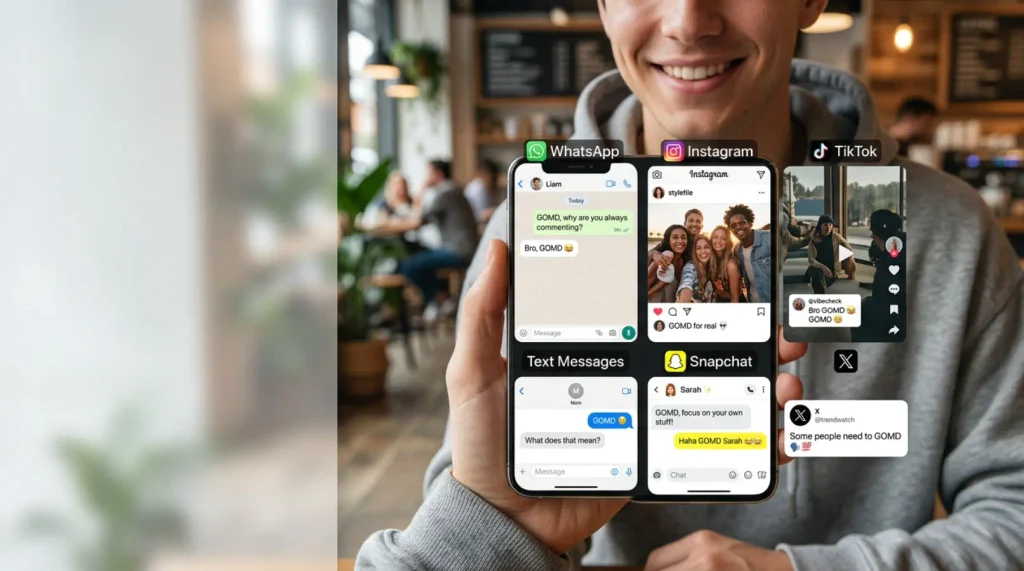
On Twitter/X
This is where GOMD originally exploded in popularity, especially as a hashtag (#GOMD) attached to tweets pushing back against critics, unsolicited advice, or online judgment. It’s often used self-referentially and somewhat humorously, as in “I do what I want, GOMD.”
Instagram, GOMD typically shows up in captions or comments as a way of preemptively shutting down criticism — for example, under a post that might attract judgmental comments, someone might caption it “GOMD” to signal they don’t want feedback.
TikTok
TikTok usage tends to be more meme-driven, often paired with humor or used as a sound bite or caption referencing the J. Cole song directly, rather than as a serious confrontation.
On Reddit
Reddit comment threads occasionally use GOMD in a similarly dismissive way, particularly in response to unsolicited criticism, moral judgment, or “well actually” style comments from other users.
Text Messages
In direct texting between friends, GOMD functions almost like an inside joke or exaggerated way of telling someone to stop teasing, nagging, or pestering — often used more playfully than aggressively between close friends.
Gaming and Discord
In gaming voice chats and Discord servers, GOMD can pop up as a quick, aggressive-but-joking response to teammates who are criticizing gameplay decisions or being overly bossy during a match.
Dating Conversations
In the Workplace
GOMD should never be used in professional or workplace communication. The explicit language makes it entirely inappropriate for emails, Slack messages, meetings, or any formal or semi-formal interaction.
Realistic Example Conversations
Example 1 — Responding to criticism:
Person A: you really shouldn’t have posted that, kinda embarrassing tbh Person B: GOMD, I’ll post what I want
Example 2 — Playful use between friends:
Friend 1: you’re STILL not done with that project? lol Friend 2: gomd I’m working on it
Example 3 — Social media caption:
Caption under a bold outfit post: “wearing this regardless of what y’all think. #GOMD”
Example 4 — Gaming context:
Teammate: why would you go that way, that’s such a bad call Player: gomd, I’m still figuring out the map
In each of these examples, notice how the tone ranges from genuinely annoyed to lightheartedly defensive — context and relationship between the speakers really shapes how harsh the phrase lands.
Common Mistakes and Misconceptions About GOMD
- Assuming it’s a “safe” acronym for any audience. Because it’s just four letters, some people underestimate how explicit the underlying phrase actually is, and use it in settings where it’s genuinely inappropriate.
- Confusing it with other “GO” acronyms. There are other internet acronyms starting with “GO” (like “GOAT” for “greatest of all time”), and newcomers sometimes assume GOMD follows a similarly tame pattern.
- Missing the J. Cole connection. Many younger users encounter GOMD purely as internet slang without realizing its strong association with a specific, well-known song, which shaped a lot of its early usage and framing.
- Using it toward someone in a position of authority. Because of its dismissive, confrontational nature, using GOMD toward a boss, teacher, or parent would be seen as extremely disrespectful, not just informal.
Tone and Connotation: Is GOMD Positive or Negative?
GOMD carries a predominantly negative, confrontational tone, though the intensity varies by context:
- Genuinely negative: In real arguments or toward actual harassment, speakers use it as a hostile, dismissive rejection.
- Playfully negative: Among friends, people often use it with a joking, exaggerated edge — more like friendly ribbing than a real confrontation.
- Defiant/empowering: In some social media contexts, people use it almost as a statement of self-assurance — “I don’t care what you think, GOMD” — projecting confident, unapologetic energy rather than pure hostility.
Regardless of the specific flavor, the phrase is never neutral or formal — it always carries at least some charge.
GOMD vs. Similar Slang Expressions
| Term | Meaning | How It Compares to GOMD |
| GTFO | “Get the f*** out” | Similarly explicit and confrontational, but tells someone to physically leave rather than stop criticizing |
| STFU | “Shut the f*** up” | Focuses specifically on silencing someone’s speech, rather than their involvement or opinion |
| Mind ya business | Stop being nosy | A softer, non-explicit alternative with essentially the same intent |
| Back off | Stop pressuring or crowding someone | A much milder, workplace-safe alternative |
| Leave me alone | Stop bothering someone | The most neutral, universally appropriate version of the same core message |
| GOAT | “Greatest of all time” | Unrelated in meaning; only similar because it also starts with “GO” |
Understanding these distinctions helps clarify that GOMD sits firmly among the more explicit, aggressive members of this family of dismissal-based slang, rather than the tamer alternatives.
Cultural Relevance and Modern Trends
Even years after its peak popularity, GOMD remains a recognizable piece of hip-hop-influenced internet slang, largely because J. Cole’s track has staying power as a well-regarded song in his catalog. It shows how music drives slang adoption across social media — a pattern that countless other lyric-derived phrases and hashtags have repeated over the years.
The phrase also illustrates a broader trend in online communication: compressing explicit, confrontational language into an acronym makes it feel slightly less intense in text form, even though the meaning underneath stays the same. This explains why acronyms like GOMD, GTFO, and STFU stay in circulation — they let people express strong reactions quickly without spelling out the more jarring language behind them.
Usage Tips: When (and When Not) to Use GOMD
If you’re considering using this term yourself, keep these guidelines in mind:
- Only use it with people who won’t be offended by explicit language. This is not a term for strangers, coworkers, or anyone in a professional relationship with you.
- Read the room before using it publicly. A caption or tweet with GOMD signals a certain tone — make sure that matches the context you’re posting in.
- Avoid it in mixed or formal group chats. Even casual family group chats or broader friend groups may include people who’d find it inappropriate.
- Understand it can come across as genuinely hostile. If you’re using it in a real disagreement, be aware the recipient may take it as a serious insult rather than lighthearted pushback.
- Know your audience’s familiarity with the term. Using it around people unfamiliar with the acronym may require you to explain what it means, which can undercut the quick, punchy effect it’s meant to have.
Frequently Asked Questions About GOMD
What does GOMD stand for exactly?
GOMD stands for “Get Off My Dick,” a slang phrase used to tell someone to stop bothering, criticizing, or interfering with you.
Is GOMD an offensive term?
Yes, GOMD contains explicit language and is generally considered vulgar or NSFW. While common in casual online and hip-hop culture, it’s not appropriate for formal, professional, or mixed-company settings.
Where did the acronym GOMD come from?
While the phrase has roots in older street vernacular, rapper J. Cole’s 2014 song “G.O.M.D.” largely drove the acronym’s mainstream popularity, bringing widespread attention to the phrase.
Is GOMD only used by men, or can anyone use it?
People use GOMD broadly across genders as general slang for “stop bothering me” or “mind your business,” and it doesn’t necessarily carry a gender-specific meaning in casual usage, despite its literal wording.
Can GOMD be used in a friendly or joking way?
Yes — close friends often use GOMD more playfully than aggressively, similar to an exaggerated, humorous way of telling someone to back off.
Is it okay to use GOMD in a work Slack message or email?
No. Since the acronym stands for explicit language, you should never use it in professional communication, regardless of how casual your workplace culture might otherwise be.
Are there non-explicit alternatives that mean the same thing as GOMD?
Yes — phrases like “mind your business,” “back off,” or “leave me alone” convey the same core message without the explicit language, making them safer for broader audiences.
Conclusion
To sum it up clearly: GOMD stands for “Get Off My Dick,” a blunt, explicit slang phrase that means “stop bothering me,” “mind your own business,” or “back off.” Its cultural rise is closely tied to J. Cole’s 2014 song “G.O.M.D.,” which pushed the acronym from niche vernacular into much broader recognition across social media and everyday texting.
The practical takeaway here is about context and audience. GOMD works fine in casual conversations among friends who won’t be bothered by explicit language, but it has no place in professional settings, formal writing, or conversations with people you don’t know well. If you ever need a safer alternative that gets the same point across, options like “mind your business” or “back off” deliver the same message without the explicit edge.
Understanding slang like this isn’t just about decoding a random string of letters — it’s about recognizing how music, culture, and online communication continue to shape the way we express frustration, set boundaries, and talk to each other in casual digital spaces.

Basra Kamal is a content writer and researcher at Top Meaning, specializing in word meanings, abbreviations, internet slang, texting terms, and modern language trends. She is passionate about making complex words and online expressions easy to understand through clear, accurate, and well-researched content. Her work helps readers quickly find reliable explanations of popular terms, phrases, and acronyms used in everyday communication and digital culture.