
You open a group chat, and someone’s reply is just two letters: “tf?” No punctuation, no explanation, just tf. If you’ve ever paused mid-scroll wondering what that meant, you’re not alone. So, what is the meaning of TF in chat, exactly?
The short answer: TF is internet slang for “the fuck,” used as an intensifier to add shock, confusion, frustration, or disbelief to a question or statement. It’s almost always paired with a question word, showing up in phrases like “what tf,” “why tf,” or “how tf.” Think of it as a punchier, shorter cousin of WTF.
This term matters because it’s everywhere in modern texting culture, showing up in group chats, comment sections, gaming lobbies, and social media replies. Misreading it, or not knowing it at all, can leave you confused mid-conversation, especially since a small handful of unrelated meanings exist too.
In this guide, we’ll break down the full TF meaning in chat, its origin, how it’s used across TikTok, Discord, Snapchat, Reddit, gaming, and dating, real conversation examples, common mistakes, and how it compares to similar expressions like WTF and STFU. By the end, you’ll never be confused by a stray tf again.
What Is the Meaning of TF in Chat? A Quick Definition
At its core, TF is shorthand for “the fuck,” used as an emotional intensifier rather than a standalone word. It rarely appears alone; instead, it attaches to a question word to boost the intensity of what’s being asked or said.
Compare these two sentences:
- “What is going on?” — neutral, calm
- “What tf is going on?” — shocked, frustrated, or genuinely confused
That extra “tf” completely shifts the tone, signaling real emotion behind the question. People typically use TF to:
- Express shock, confusion, or disbelief
- Add emphasis to a reaction or complaint
- Intensify a question like “who,” “why,” “how,” or “where”
- React to something unexpected or frustrating
The Origin and History Behind TF in Chat
Understanding where TF came from helps explain why it carries so much emotional weight today.
Roots in Spoken English
The full phrase, “the fuck,” has existed in spoken English as an intensifier for over a century, with “the fuck” style phrasing appearing as far back as the early 1900s as a stronger alternative to “the hell.” Phrases like “what the fuck is that?” have been common in American slang since at least the 1960s.
From WTF to TF: The Texting Era
The abbreviated “tf” emerged from early internet chat rooms and SMS texting in the late 1990s and early 2000s. Platforms like AOL Instant Messenger (AIM) and IRC (Internet Relay Chat) popularized “tf” alongside related abbreviations like “wtf” (what the fuck) and “stfu” (shut the fuck up), as users looked for faster ways to type common phrases.
Character Limits Accelerated the Trend
As texting and platforms like early Twitter, with its 140-character limit, became more popular, abbreviations like TF spread even further. Speed and brevity mattered, and TF fit perfectly: quick to type, strong in impact.
Mainstream Adoption Through Social Media
By the 2010s, TF had fully crossed over from gaming and forum culture into everyday texting, spreading across Twitter, Instagram, TikTok, and Discord. Today, it remains one of the most recognizable abbreviations in internet slang, especially among Gen Z and younger millennials.
The Different Meanings of TF (In Order of Popularity)
While “the fuck” is by far the dominant meaning, a few other definitions exist depending on context. Here’s a breakdown, ranked from most to least common.
1. The Fuck (Most Common, By Far)
This is the meaning almost everyone means when they type tf in a casual chat. It intensifies a question or reaction.
Example: “Bro, tf happened here? 😂”
2. Team Fight (Gaming Context)
In certain gaming communities, particularly in strategy or MOBA-style games, TF can refer to a “team fight,” a coordinated battle between two teams.
Example: “We need to group up for the next tf.”
3. Team Fortress (Gaming Reference)
TF is also widely recognized as shorthand for Team Fortress, the popular video game franchise, especially “Team Fortress 2” (often written as TF2).
Example: “Anyone want to hop on TF2 tonight?”
4. Transformation (Fandom and Creative Writing)
Within certain online communities, such as furry fandom or creative writing spaces, TF can stand for “transformation,” referring to a character changing form.
Example: “My character finally reached TF!”
5. Task Force (Formal/Professional Context)
In business, government, or professional settings, TF can simply mean “task force,” a group assembled for a specific project or purpose.
Example: “The TF will review the proposal next week.”
Outside of gaming, fandom, or professional contexts, if you see “tf” in a casual text or comment, it overwhelmingly means “the fuck.”
TF Meaning Across Different Platforms
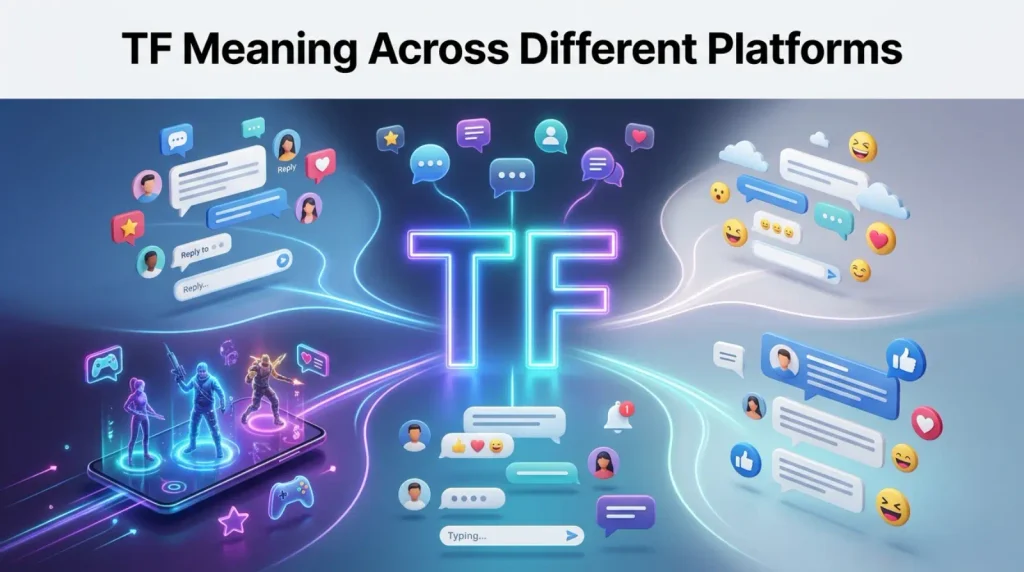
Context and platform shape how TF typically gets used. Here’s how it shows up across popular apps.
TF in Text Messages
In regular texting, TF almost always functions as an intensifier attached to a question, expressing shock, confusion, or frustration.
TF on TikTok
On TikTok, TF appears constantly in comment sections and captions, often reacting to surprising or chaotic videos with phrases like “wait tf” or “why tf.”
TF on Instagram
Instagram usage mirrors TikTok, with TF showing up in comments and captions to express strong reactions to posts or stories.
TF on Snapchat
On Snapchat, TF typically reflects surprised or amused reactions in private conversations between friends.
TF on Discord
In gaming-heavy Discord servers, TF can mean either the swear-based intensifier or “team fight” and “Team Fortress,” depending on the server’s focus.
TF on Reddit
Reddit comments frequently use TF to express disbelief or reaction to a post, especially in casual or meme-focused subreddits.
TF in Gaming Chat
This is where context matters most. In gaming, TF might mean “the fuck” as a reaction, or it might specifically mean “team fight” or reference Team Fortress, depending on the game being played.
TF in Dating Conversations
In dating app messages or flirty texting, TF often expresses playful shock or disbelief, such as reacting to a bold or surprising comment.
TF in Workplace Conversations
As slang, TF has no place in professional communication. The answer is an emphatic no in almost all workplace settings, since even casual internal chats carry the risk of the wrong recipient seeing it. However, “TF” as “task force” remains entirely appropriate in formal business contexts.
Real Conversation Examples
Seeing TF in real conversations makes its meaning much clearer.
Example 1 (Shock or confusion):
“Bro, tf happened here? 😂” “Long story, you missed everything.”
Example 2 (Frustration):
“Why tf would he say that to her?”
Example 3 (Standing alone as a reaction):
“Tf?” “I know, right? Nobody saw that coming.”
Example 4 (Gaming-specific meaning):
“My character finally reached TF!” “Nice transformation!”
TF vs. Similar Expressions: Comparison Table
| Term | Meaning | Common Tone | Formal Use? |
| TF | “The fuck,” intensifies a reaction | Shocked, frustrated, playful | No |
| WTF | “What the fuck” | Surprised, exasperated | No |
| STFU | “Shut the fuck up” | Blunt, dismissive | No |
| TFW | “That feeling when” | Relatable, humorous | No |
| OMFG | “Oh my fucking god” | Extreme surprise or excitement | No |
The key difference is that TF functions as an attachment, boosting the intensity of a question word, while terms like WTF and OMFG stand more on their own as complete reactions.
Common Mistakes People Make With TF
Even frequent texters misuse or misread TF sometimes. Here are the most common slip-ups.
- Using it in professional settings. It reads as unprofessional and inappropriate in almost any work environment.
- Assuming TF always means the swear. In gaming or fandom contexts, it might mean “team fight,” “Team Fortress,” or “transformation” instead.
- Responding literally instead of casually. Reacting with the actual swear word out loud misses the point of the abbreviation entirely.
- Overusing it until it loses impact. If every sentence includes tf, the emphasis stops landing.
- Ignoring surrounding context. TF rarely explains itself; the conversation around it usually clarifies which meaning applies.
Positive and Negative Connotations
Like most slang intensifiers, the tone behind TF depends heavily on context and relationship.
Positive or playful connotations:
- Reacting to something funny or surprising among friends
- Adding lighthearted emphasis to a joke or reaction
- Expressing genuine excitement or disbelief in a good way
Negative connotations:
- Signaling real anger or frustration in a heated argument
- Coming across as confrontational if used with someone unfamiliar
- Sounding harsh or rude in the wrong setting, especially with strangers or coworkers
Between close friends, TF can sound playful and funny. In a heated argument, the exact same phrase can feel sharp and aggressive, so tone and relationship matter significantly.
Misconceptions About TF in Chat
Let’s clear up a few common myths.
- Myth: TF only attaches to “what.” In reality, it pairs with many question words: why tf, who tf, how tf, where tf, when tf.
- Myth: TF can’t stand alone. While it usually attaches to a question word, it can also stand alone as “tf?” meaning “what the fuck?”
- Myth: TF is a brand-new term. The full phrase “the fuck” has been used as an intensifier in spoken English for over a century.
- Myth: TF always means the swear. Depending on context, especially in gaming or professional settings, it can mean something completely unrelated.
Cultural Relevance and Modern Trends
The continued popularity of TF reflects a broader trend in digital slang: turning strong spoken intensifiers into fast, typed shorthand. Similar patterns exist with WTF, OMFG, and STFU, all serving the same basic purpose of adding emotional weight quickly.
TF has spread globally, appearing even in non-English conversations as a borrowed English slang term. Gen Z and younger millennials use it fluidly across memes, comments, and private chats, and its frequency shows no signs of slowing down heading into 2026, even as usage patterns shift slightly across different platforms and age groups.
Summary Table: TF Meaning Key Facts
| Category | Details |
| Primary Meaning | “The fuck” — an intensifier for questions and reactions |
| Other Meanings | Team Fight, Team Fortress, Transformation, Task Force |
| Origin | Early 2000s internet chat rooms (AIM, IRC), rooted in older spoken slang |
| Popularized Through | Twitter, Instagram, TikTok, Discord |
| Common Platforms | Texting, TikTok, Snapchat, Discord, gaming chats |
| Tone | Shocked, frustrated, playful, depending on context |
| Related Terms | WTF, STFU, TFW, OMFG |
| Workplace Appropriate? | No (except as “task force”) |
Frequently Asked Questions
What does TF mean in a text message?
It most commonly means “the fuck,” used as an intensifier to express shock, confusion, or frustration, usually attached to a question word like “what” or “why.”
Can TF stand alone in a sentence?
Yes. While it usually attaches to a question word, TF can also stand alone as “tf?” which functions the same way as asking “what the fuck?”
Is TF the same as WTF?
They’re closely related. TF is essentially a shorter, punchier version of WTF, often used mid-sentence rather than as a standalone exclamation.
Does TF always mean the swear word?
No. In gaming contexts, it can mean “team fight” or reference “Team Fortress,” and in professional settings, it can simply mean “task force.”
Is it okay to use TF at work?
No, not as slang. It’s considered inappropriate in professional communication, though “TF” meaning “task force” remains acceptable in formal business contexts.
What’s the difference between TF and TFW?
TF intensifies a question or reaction, while TFW stands for “that feeling when,” typically used to introduce a relatable or humorous scenario.
Why do people use TF instead of typing the full phrase?
It’s faster to type and carries the same emotional impact, fitting the fast-paced, brevity-focused nature of texting and social media.
Can TF sound rude or aggressive?
Yes, depending on tone and relationship. Among close friends, it often sounds playful, but in arguments or with strangers, it can come across as harsh.
Is TF popular across all age groups?
It’s most common among Gen Z and younger millennials, though its widespread use across platforms means many older users recognize it as well.
Conclusion
So, what is the meaning of TF in chat? In the vast majority of cases, it’s shorthand for “the fuck,” a quick, punchy way to intensify a question or reaction, showing shock, confusion, or frustration. A handful of unrelated meanings, like “team fight” or “task force,” exist in specific gaming or professional contexts, but they’re the exception rather than the rule.
Now that you understand where TF came from and how it’s used across texting, gaming, and social media, you’ll never have to wonder what someone means the next time it shows up in your chat.

Basra Kamal is a content writer and researcher at Top Meaning, specializing in word meanings, abbreviations, internet slang, texting terms, and modern language trends. She is passionate about making complex words and online expressions easy to understand through clear, accurate, and well-researched content. Her work helps readers quickly find reliable explanations of popular terms, phrases, and acronyms used in everyday communication and digital culture.







2 thoughts on “What Is the Meaning of TF in Chat? The Complete Guide”