You’re scrolling through a group chat and someone sends “what tf is that supposed to mean?” Or you’re in a Discord server and a teammate types “how tf did you survive that?” You’ve seen it dozens of times, but you may still wonder what those two little letters stand for and whether it’s okay to use them yourself.
Here’s the short version: what TF means in text is almost always “the f***,” a shortened, censored form of a common curse phrase. It’s a quick way to add emphasis, shock, humor, or frustration to a question or statement. It’s the sibling of WTF, and it shows up across texting slang, TikTok comments, Snapchat chats, Reddit threads, and gaming lobbies.
But TF meaning isn’t always that simple. Depending on where you see it, TF can also stand for Team Fortress, transformation, trust fund, or even a technical term like timeframe. Context matters a lot.
This guide covers what TF means, where it came from, and how people use it on every major platform. It also covers when it’s a bad idea to type it, and what to say instead. By the end, you’ll read and use it with confidence.
What Does TF Mean in Text? (Quick Answer)
TF most commonly means “the f*”** in text messages and social media. People use it as an intensifier, usually after a question word like what, who, why, or how.
- Full phrase: the f***
- Function: adds emphasis, surprise, annoyance, or humor
- Tone: informal and profane (mild to strong depending on context)
- Typical usage: “What tf are you doing?” / “Who tf is that?”
- Other meanings: thank f***, Team Fortress, transformation, trust fund, timeframe
If you remember only one thing, remember this: TF is an informal, profane emphasizer, and it’s not for formal or professional settings.
The Main Meaning of TF: “The F***”
The abbreviation works because English speakers often insert a curse word into a question to make it sound stronger. “What are you doing?” is neutral. “What the f*** are you doing?” is heated. Shortened for texting, that becomes “what tf are you doing?”
How TF Works Grammatically
TF is an intensifier. It doesn’t change the meaning of a sentence. It changes the feeling. Removing it leaves a perfectly normal sentence:
- “What tf is this?” → “What is this?”
- “Who said that?” → “Who said that?”
- “Get tf out of here.” → “Get out of here.”
That last example shows something useful: TF doesn’t have to sit right after a question word. People also drop it into the middle of phrases like “shut tf up,” “stop tf playing,” or “sit tf down.” In each case it turns up the volume.
Common TF Phrases and What They Mean
| Phrase | What It Means | Typical Tone |
| what tf | “What the f***?” | Shock, confusion, anger |
| who tf | “Who the f***?” | Confusion, irritation |
| why tf | “Why the f***?” | Frustration, disbelief |
| how tf | “How the f***?” | Disbelief or amazement |
| where tf | “Where the f***?” | Impatience |
| when tf | “When the f***?” | Impatience, confusion |
| tf is wrong with you | “What the f*** Is it wrong with you?” | Angry or joking |
| tf you mean | “What the f*** Do you mean?” | Defensive, confused |
| bro tf | “Bro, what the f***?” | Casual disbelief |
| tf outta here | “Get the f*** out of here” | Playful disbelief or dismissal |
You’ll also see TF stand alone as a reaction, often with question marks: “tf??” It reads as a blunt “what on earth?”
Other Meanings of TF (Ranked by How Common They Are)
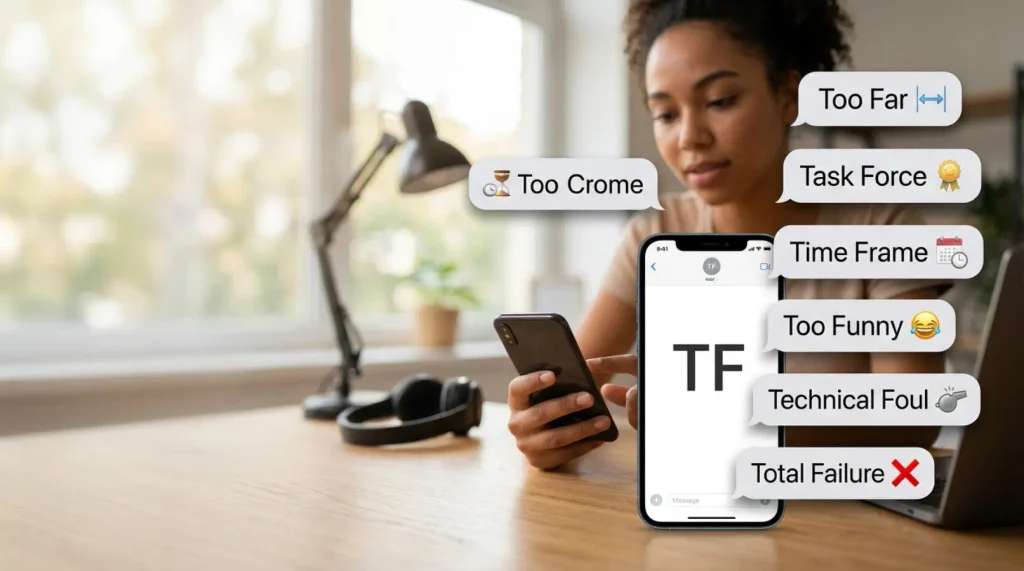
Because TF is so short, it gets used for several things. Here they are roughly in order of how often you’ll run into them, along with how to tell them apart.
1. “The F***” (by far the most common)
This is the meaning in nearly every text conversation, comment section, and group chat. Unless the context clearly points elsewhere, assume this is what someone means.
2. “Thank F***”
A less common use is “thank f***,” as in “TF that’s over” or “tf it’s Friday.” It expresses relief. You’ll see it far less often than “the f***,” and it’s usually clear from the sentence. If TF shows up right before “it’s over,” “you’re here,” or a similar relieved statement, this is probably what’s meant.
3. Team Fortress (TF2)
In gaming, especially on Steam, Discord, and Reddit, TF often refers to Team Fortress, most commonly Team Fortress 2 (usually written TF2). If someone says “want to play TF tonight?” or “TF2 server is lagging,” they’re talking about the game, not swearing.
4. Transformation
In fan communities, TF is shorthand for transformation, as in a character changing form in a story, comic, or piece of fan fiction. It’s an established term in some online fandoms and creative writing communities. If you see it on an art or fiction site, or attached to a fan work, that’s likely the meaning.
5. Transformers
Fans of the Transformers franchise sometimes abbreviate the name as “TF,” particularly in fan forums and collector groups.
6. Trust Fund
In casual conversation, “TF” can stand for trust fund, as in “TF kid,” meaning someone from a wealthy family. It’s typically written out or clear from context.
7. Technical and Professional Uses
Outside slang, TF appears in several fields:
- Programming: tf is the standard alias for TensorFlow in Python code (import tensorflow as tf).
- Trading and charting: TF is a common shorthand for timeframe.
- Government and military: TF can stand for task force.
- Science: In biology, TF can mean transcription factor.
If you’re in a coding channel, a trading forum, or a research paper, TF almost certainly means one of these. That’s another reason context is everything.
Origin and History: Where Did TF Come From?
TF is a shortened cousin of WTF (“what the f***”), one of the best-known abbreviations in internet and texting culture. Abbreviating profanity is an old habit. People have long used partial spellings, symbols, and shorthand to soften or speed up curse words. Once early chat rooms, forums, and SMS made typing costly (in time and, on early phones, in characters and effort), acronyms like WTF, LOL, and OMG spread quickly.
TF grew out of that pattern. Once “what the f***” became WTF, people began splitting the phrase apart. “What tf” is basically WTF broken back into its two natural pieces, which lets the speaker swap in any question word: who tf, why tf, how tf. That flexibility is why TF took off as its own unit rather than just a fragment of WTF.
The rise of smartphones, autocomplete, and fast-moving apps like Snapchat, Instagram, and TikTok also pushed language toward shorter forms. Lowercase, punctuation-free typing became the norm in casual chat, and “tf” fit right in.
I can’t point to a single definitive first use of “tf” in this sense, and anyone claiming a precise date is likely guessing. What’s clear is that it’s a natural evolution of WTF and became widespread through texting and social media.
TF vs. WTF vs. Similar Expressions
People often ask how TF differs from WTF and other slang. Here’s a side-by-side look.
| Term | Stands For | Usage | Intensity |
| TF | the f*** | Mid-sentence intensifier (“what tf is this”) | Strong |
| WTF | what the f*** | Standalone reaction or sentence opener | Strong |
| STFU | shut the f*** up | Command, often rude | Very strong |
| GTFO | get the f*** out | Command; often playful | Strong |
| WTH | what the heck/hell | Softer reaction | Mild |
| FML | f*** my life | Complaint | Strong |
| IDK tf | I don’t know the f*** | Casual frustration | Strong |
The main difference between TF and WTF is structure. WTF is a fixed phrase that usually works on its own (“WTF?!”). TF is a flexible add-on that slots into a sentence after a question word or a verb.
How People Use TF on Different Platforms
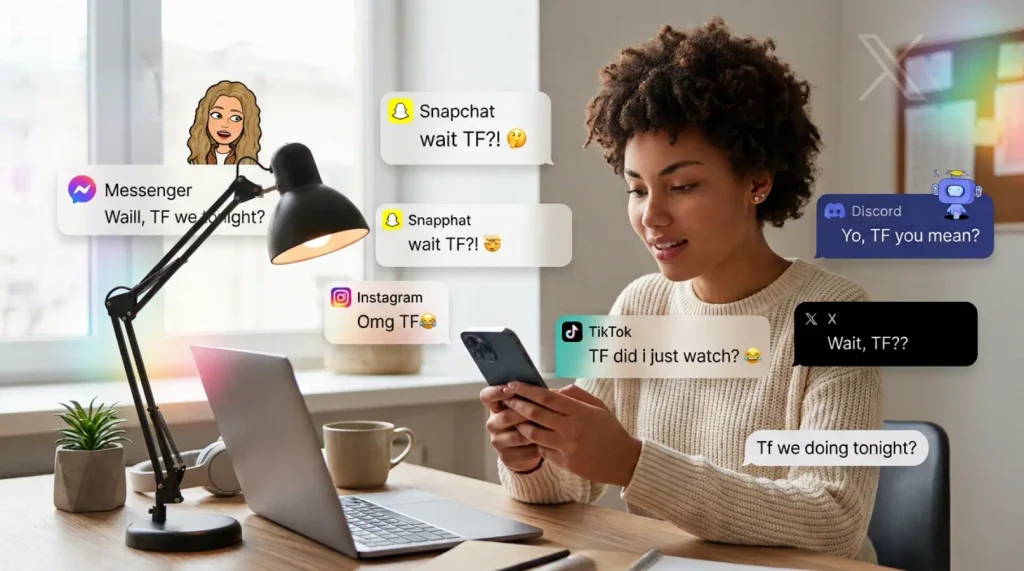
Text Messages
In texts with friends, TF is casual and common. It signals a relaxed tone: “what time is it lol.” Between close friends it’s rarely taken as aggressive. Between people who don’t know each other well, it can be seen as rude.
TikTok
TikTok comments are full of it. You’ll see “how tf did she do that??” under impressive videos and “who tf asked” under hot takes. Here TF often signals amazement or playful sarcasm. Creators sometimes censor it in captions to avoid content moderation.
On Instagram, TF appears mostly in comments and DMs, often as a reaction to memes or surprising posts. Because Instagram is more polished and brand-oriented, you’ll see it less in public captions.
Snapchat
Snapchat chats are informal and fast, so TF fits naturally. It’s common in quick reactions: “bro tf” alongside a photo of something ridiculous.
Discord
Discord servers vary. In gaming and friend servers, TF is everywhere. In moderated communities with strict language rules, it may be flagged. Also watch for the Team Fortress meaning in gaming servers.
Reddit users use TF in comments and titles, though subreddits differ in how strictly they moderate profanity. A title like “Anyone else wonder how tf this works?” is common.
Gaming
In lobbies and voice chats, TF is a reaction to a bad play or a surprising moment: “how tf did you miss that?” In games with Team Fortress communities, it may also just be the name of the game.
Dating and Relationships
In dating apps and texts, TF can show up in banter (“what tf are you wearing 😂”) or in tense moments (“tf you mean you forgot?”). It amplifies emotion in both directions, so be careful. What sounds funny in person can sound harsh in text.
Workplace Conversations
Avoid it. TF is profane, and even in casual workplace chat tools like Slack, using it can come across as unprofessional. The exception is when TF means something technical, like TensorFlow or timeframe. Even then, spell it out in anything formal.
Tone and Connotations: Is TF Positive or Negative?
TF is neutral on its own. The tone comes from what surrounds it.
Negative uses:
- Anger: “Who tf do you think you are?”
- Frustration: “Why tf is this app crashing again?”
- Disrespect: “Tf you talking about?”
Positive or playful uses:
- Amazement: “How tf did you learn to cook like that?”
- Humor: “This cat is tf adorable” (less common, but it happens)
- Admiration: “Bro tf, that was confusing!”
Neutral or confused:
- Simple bewilderment: “What tf is a ‘rizz’?”
Because text has no tone of voice, the same message can land very differently. Emojis and punctuation help: “what tf 😂” reads playful, while “what tf.” reads cold.
Realistic Conversation Examples
Example 1: Confusion
Maya: did you see the new policy email? Jordan: yeah what tf does “synergize deliverables” even mean 😭
Example 2: Amazement
Sam: I just beat the final boss on my first try Chris: how tf??
Example 3: Frustration
Alex: why tf is the wifi down AGAIN Riley: router’s probably fried, restart it
Example 4: Gaming (Team Fortress meaning)
Dev: anyone down for TF2 tonight? Kai: yeah, give me 20 min
Example 5: Relief (“thank f*”)**
Priya: finals are over Taylor: tf, I need a nap
Example 6: A tense moment
Chris: you forgot my birthday? Jordan: tf you mean? I planned dinner
Notice how much the context shapes each one.
Common Mistakes and Misconceptions
- Assuming it’s always vulgar. Sometimes it means Team Fortress, transformation, or TensorFlow. Read the context first.
- Using it with the wrong audience. It’s fine among friends, but risky with family members, teachers, or coworkers.
- Confusing it with WTF. They’re related but not identical. TF is an add-on, WTF is a full phrase.
- Thinking it’s always angry. Plenty of uses are playful or admiring.
- Overusing it. Peppering every message with TF loses the emphasis and can make you sound aggressive.
- Forgetting platform rules. Some servers, games, and forums filter or ban profanity, abbreviated or not.
When Not to Use TF (and What to Say Instead)
Skip TF in professional emails, school assignments, customer messages, and conversations with people you don’t know well. Abbreviating a curse doesn’t make it clean, since the meaning is still obvious to most readers.
Cleaner alternatives:
| Instead of… | Try… |
| what tf | what the heck / what on earth |
| who tf | who exactly / who on earth |
| why tf | why on earth / why in the world |
| how tf | how in the world |
| tf you mean | what do you mean |
| tf is wrong with you | what’s going on with you |
| wtf | wth / what the heck |
These keep the same emphasis without the profanity.
Related Slang and Terms
If you’re learning texting slang, these are useful to know alongside TF:
- WTF: what the f***
- STFU: shut the f*** up
- GTFO: get the f*** out
- IDGAF: I don’t give a f***
- TBH: to be honest
- SMH: shaking my head
- IDK: I don’t know
- FR / fr: for real
- NGL: not gonna lie
- BRUH: casual reaction to disbelief or annoyance
TF fits naturally into this family of informal reaction shorthand.
Quick Summary Table
| Category | Details |
| Term | TF |
| Most common meaning | “The f***” |
| Other meanings | Thank f***, Team Fortress, transformation, Transformers, trust fund, TensorFlow, timeframe, task force |
| Origin | Split from WTF as texting and internet slang evolved |
| Common platforms | Texts, TikTok, Snapchat, Instagram, Discord, Reddit, gaming |
| Tone | Informal, profane; can be angry, playful, or amazed |
| Popularity | Very common in casual online chat, especially among younger users |
| Formality | Not suitable for professional or formal settings |
| Related terms | WTF, STFU, GTFO, WTH, IDGAF |
Frequently Asked Questions
Is TF a bad word?
The abbreviation stands for a profane phrase, so most people treat it as a curse word even though it’s shortened. It’s milder than spelling it out in full, but it’s still not appropriate in formal or professional settings.
Can I use TF around my parents or teachers?
It’s best not to. Because the meaning is widely understood, it can come across as disrespectful. Save it for close friends, and even then read the room.
Does TF always mean the same thing as WTF?
Not exactly. WTF is usually a standalone expression of shock (“WTF?”), while TF is a smaller piece that plugs into a sentence (“what tf is that”). They share a root but work differently.
What does “tf you mean” say?
It’s short for “what the f*** do you mean?” People use it when they’re confused, offended, or pushing back on something someone said. Depending on tone, it can sound defensive or just bewildered.
What does “TF” mean in gaming?
Most often it refers to Team Fortress, especially TF2. In in-game chat, though, it can just as easily be the profane meaning, as in “how tf did that hit me?” Check the surrounding text.
Is it okay to use TF on TikTok or Instagram?
Generally yes in comments and DMs, since the tone is casual. Some creators censor it in captions or voiceovers to avoid moderation flags or to keep their content brand-friendly.
Why do people write “tf” in lowercase?
Casual texting tends to skip capitalization. Lowercase “tf” signals a relaxed, conversational tone, while uppercase “TF” can feel louder or more emphatic.
Can TF ever be used in a positive way?
Yes. “How tf did you do that?” is often an admiring reaction, and “bro tf, that was amazing” expresses excitement. Tone and emojis usually make the intent clear.
What’s the difference between “tf” and “thank f***”?
They share the same letters, but “thank f***” is a much rarer usage expressing relief, such as “tf it’s Friday.” If you see TF after a question word, it almost certainly means “the f***.”
How do I know which meaning of TF someone intends?
Look at the platform, the sentence structure, and the topic. Question word plus TF means “the f***.” A game name means Team Fortress. A code snippet means TensorFlow. A chart or trading context means timeframe.
Conclusion
So, what does TF mean in text? In the vast majority of cases, it’s shorthand for “the f***,” an informal, profane intensifier that adds surprise, frustration, or humor to a question or command. It grew out of WTF and took off because it’s short, flexible, and fits the fast, lowercase style of modern texting and social media.
Some key takeaways:
- Context decides meaning. TF can also mean Team Fortress, transformation, trust fund, timeframe, or TensorFlow.
- Tone is everything. The same “how tf” can be admiring or aggressive depending on the message and emojis around it.
- Know your audience. It’s fine among friends, but avoid it at work, in school, or with people you don’t know well.
- You have alternatives. “What the heck” and “how in the world” carry the same energy without the profanity.
Next time you spot “what tf” in a group chat, you’ll know what it means, how it’s meant, and whether it’s worth typing yourself.

Basra Kamal is a content writer and researcher at Top Meaning, specializing in word meanings, abbreviations, internet slang, texting terms, and modern language trends. She is passionate about making complex words and online expressions easy to understand through clear, accurate, and well-researched content. Her work helps readers quickly find reliable explanations of popular terms, phrases, and acronyms used in everyday communication and digital culture.