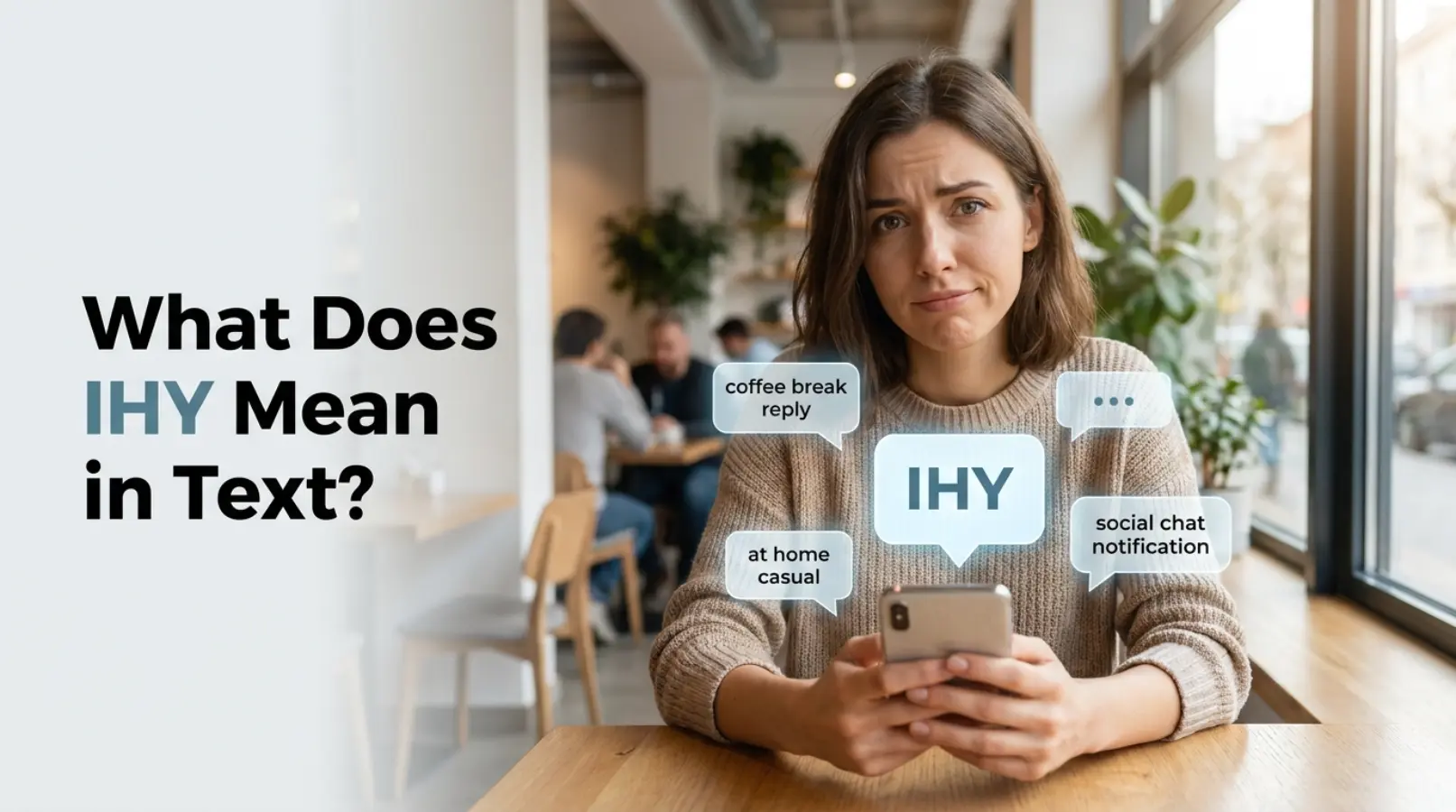
You’re texting a friend, they tell you they just booked a last-minute trip to Cabo, and you reply with a single line: “ihy.” No further explanation. No context. Just three letters. If you’ve ever sent or received this and wondered whether you should be offended, flattered, or confused, you’ve landed in the right place. IHY is one of those texting abbreviations that looks aggressive on the surface but almost never means what it literally says.
Here’s the quick answer: IHY stands for “I Hate You.” But in nearly every real conversation, it’s not meant literally. It’s a sarcastic, joking, or jealousy-driven reaction to something impressive, lucky, or mildly annoying that someone else just did. Think of it as the cheeky, exaggerated cousin of “ILY” (I love you) — same emotional intensity, opposite direction, and almost always said with a smirk rather than a scowl.
This guide covers everything you need to know: the true IHY meaning in text, where the phrase came from, how tone and emojis completely change its message, and how it shows up differently across texting, TikTok, Snapchat, Instagram, Discord, Reddit, gaming chats, dating apps, and even workplace conversations. You’ll also get real conversation examples, common mistakes people make when sending or reading it, a full comparison against similar slang like IH8U and ILY, and a handy summary table so you never have to second-guess this abbreviation again.
Quick Answer: IHY Meaning at a Glance
IHY = “I Hate You.”
In the overwhelming majority of cases, IHY is used ironically, not literally. People send it when they’re:
- Jealous of something good happening to a friend
- Playfully annoyed after losing a game, a bet, or an argument
- Reacting to a friend’s good luck, new purchase, or exciting news
- Teasing someone they actually care about
Less commonly, IHY can stand for “I Hear You” (acknowledging what someone said) or “I Heart You” (an affectionate variation), though both of these alternate meanings have mostly fallen out of everyday use. In rare, serious contexts — like the middle of a real argument — IHY can carry genuine anger. Reading the room is everything with this one.
What Does IHY Actually Mean in a Text Message?
At face value, “I Hate You” sounds harsh. But text slang rarely works at face value, and IHY is a textbook example of irony-driven internet language. According to language references that track internet acronyms, IHY is most often used with a wink — expressing envy, playful frustration, or exaggerated reaction rather than actual hatred.
Picture this: your best friend texts you a photo of the two front-row concert tickets they just scored. You didn’t get tickets. Your reply? “ihy 😭.” You don’t actually hate them. You’re thrilled for them and devastated for yourself at the same time, and “ihy” captures that exact mixed emotion faster than any full sentence could.
That’s the core function of IHY: it’s an emotional shortcut. Instead of typing out “I’m so jealous of you right now but also happy for you and slightly annoyed,” people compress all of that into three letters and let the context fill in the rest.
The Three Meanings of IHY (Ranked by How Often They’re Used)
1. “I Hate You” (Sarcastic/Playful) — By Far the Most Common
This is the meaning you’ll encounter in probably 90% of real conversations. It’s almost never literal. Common triggers include:
- A friend shares exciting news you wish was yours
- Someone wins a game, contest, or argument against you
- A friend posts a flattering photo and you’re feeling competitive
- Someone teases you and you’re firing back playfully
Example:
“just got upgraded to first class for free” “IHY. some people really do have main character energy”
2. “I Hate You” (Genuine/Serious) — Rare, But Real
In the middle of an actual argument, breakup, or serious conflict, IHY can mean exactly what it says. The giveaway is usually the surrounding conversation — no emojis, no lightheartedness, often paired with other angry or hurt language.
Example:
“I can’t believe you told everyone what I said in private” “IHY right now, I mean it”
3. “I Hear You” or “I Heart You” — Mostly Outdated
Early internet slang glossaries from the mid-2000s occasionally listed IHY as shorthand for “I hear you” (acknowledgment) or “I heart you” (affection). These uses have largely faded as “I hate you” became the dominant interpretation, but you might still spot them in older forum threads or from users who picked up the abbreviation years ago.
The Origin and History of IHY
Like most internet acronyms, IHY doesn’t trace back to one specific person or platform. It emerged gradually as chatroom and instant-messaging culture pushed people to compress emotional phrases into fast, typable shorthand.
Here’s the general timeline:
- Mid-2000s: Early chatroom and IM slang. As AIM, MySpace comments, and early texting culture took off, users began abbreviating common phrases. “I love you” became “ILY,” and its dramatic opposite, “I hate you,” naturally followed as “IHY.”
- Late 2000s: Irony becomes the default tone. By the time IHY appeared regularly on slang glossaries, it was already understood as mostly sarcastic — a playful jab rather than a genuine insult. Early internet culture leaned heavily into exaggerated, dramatic language for comedic effect, and IHY fit right in.
- 2010s: Texting and early social media adoption. As smartphones made texting the primary mode of communication for teens and young adults, short acronyms like IHY, ILY, IDK, and TBH became second nature, especially in fast back-and-forth conversations.
- 2020s–2026: TikTok, Snapchat, and comment culture keep it alive. Modern platforms built around quick reactions and captions gave IHY a second wind. It’s become a go-to caption or comment for expressing “good-natured jealousy” — the exact phrase often used to describe this tone in slang references.
IHY Across Different Platforms and Situations

Slang doesn’t behave identically everywhere. Here’s how IHY shows up depending on where — and with whom — you’re texting.
IHY in Regular Texting
In everyday SMS or iMessage conversations, IHY usually pops up as a quick reaction to news, photos, or updates a friend shares. It’s rarely a conversation starter; it’s almost always a reply.
Example:
“guess who just got the job 👀” “IHY!! so proud of you though fr”
IHY on TikTok
On TikTok, IHY frequently shows up in comments and captions under content that triggers relatable envy or humor — a friend’s glow-up video, a “day in my life” post showing off a dream vacation, or a lucky thrift-store find. Creators sometimes use it in their own captions to preemptively joke about the reaction they expect (“ihy in advance to everyone who’s about to be jealous of this haul”).
IHY on Snapchat
Snapchat’s fast, personal, and often visual format makes IHY a natural fit for reacting to snaps — a cute outfit, a nice meal, a scenic view. Because Snapchat conversations tend to happen between close friends, the sarcastic and affectionate uses of IHY are especially common here.
IHY on Instagram
On Instagram, IHY shows up in comment sections and DMs, usually reacting to a post that triggers playful envy — a new outfit, a vacation photo, an achievement post. It functions almost identically to its TikTok usage but tends to be slightly more comment-focused than caption-focused.
IHY on Discord and in Gaming Chats
In gaming communities, IHY often follows a loss, an unlucky drop, or a friend’s lucky win. It’s a quick way to express competitive frustration without sounding genuinely upset.
Example:
“got the legendary skin on my first pull 💀” “IHY. i’ve been grinding for weeks”
IHY on Reddit
Reddit threads sometimes use IHY in reply comments reacting to someone’s good fortune, clever solution, or impressive result — similar to gaming chat usage, but text-based and often paired with dry humor rather than emojis.
IHY in Dating and Flirting
In dating app conversations or early-stage texting, IHY can take on a flirty, teasing tone. It often shows up after a compliment, a confident joke, or when one person feels playfully outmatched in banter.
Example:
“I’m just built different I guess” “IHY, that’s so annoying but also kind of hot”
IHY in the Workplace
This is where the rulebook changes. IHY is not appropriate for professional communication, even as a joke. Work emails, Slack channels, and team chats call for clear, respectful language — “I hate you” in any form, even sarcastically, can be misread by coworkers who don’t share the same texting shorthand, or simply come across as unprofessional. Stick to phrases like “no fair!” or “so jealous!” if you want to keep the same energy without the risk.
Common Mistakes People Make With IHY
Even once you understand the general meaning, there are a few easy ways to misuse or misread IHY.
- Taking it literally when it’s clearly playful. If someone sends IHY right after sharing good news or a joke, they almost certainly don’t mean it. Don’t panic or overreact.
- Sending it to someone who doesn’t know the abbreviation. Not everyone — especially older relatives, new coworkers, or casual acquaintances — will read IHY as a joke. Without shared context, it can come across as genuinely hostile.
- Using it during a real argument and assuming it’ll be read as a joke. Tone doesn’t always translate through text. If a conversation is already tense, adding IHY can escalate things rather than lighten them.
- Confusing it with IH8U. These mean the same thing (“I hate you”), but IH8U is an older, more retro version of the abbreviation, popular in early 2000s texting and less common today.
- Using it in professional or formal messages. As covered above, this almost always lands wrong in a work context.
Positive vs. Negative Connotations
IHY’s meaning depends heavily on delivery, but here’s how it typically breaks down:
Positive/lighthearted connotations:
- Good-natured jealousy over a friend’s exciting news
- Playful teasing between close friends or romantic partners
- A humorous, exaggerated reaction to something impressive or funny
Negative connotations:
- Genuine anger or frustration during a real conflict
- Passive-aggressive jabs disguised as jokes
- Miscommunication with someone unfamiliar with the slang, leading to hurt feelings
Because the phrase can swing so dramatically between “I’m obsessed with you, this is a compliment” and “I am genuinely upset with you,” it’s best used with people who already understand your sense of humor and texting style.
IHY vs. Similar Slang Terms
Here’s how IHY compares to related abbreviations you might see in the same conversations.
| Term | Meaning | Typical Tone |
|---|---|---|
| IHY | I Hate You | Usually sarcastic/jealous; occasionally genuine |
| IH8U | I Hate You | Same meaning as IHY, more old-school/retro |
| ILY | I Love You | Sincere, affectionate |
| ILYSM | I Love You So Much | Sincere, more intense than ILY |
| SMH | Shaking My Head | Disapproval or disbelief |
| FOMO | Fear Of Missing Out | Describes the jealousy IHY often expresses |
| NGL | Not Gonna Lie | Honesty marker |
| JK | Just Kidding | Clarifies a joke wasn’t serious |
The closest relative to IHY is IH8U — they’re functionally identical, just from slightly different eras of texting culture. IHY is more common in modern texting and social media, while IH8U shows up more in older forum posts, early 2000s MSN/AIM chat logs, and nostalgic slang references.
Why IHY Matters: Cultural Relevance and Modern Trends
IHY reflects a broader pattern in how digital communication handles complex emotions:
- Irony as an emotional shortcut. Rather than typing “I’m jealous but happy for you,” users compress that entire feeling into a phrase that says the opposite of what they mean, trusting that tone and context will carry the real message. This mirrors similar ironic slang like calling something “sick” or “insane” to mean impressive rather than literally sick or insane.
- Compressed language for fast-paced platforms. TikTok comments, Snapchat replies, and Discord chats reward speed. A three-letter reaction does the emotional work of a full sentence in a fraction of the time.
- Generational and platform-specific usage. IHY skews younger, showing up most in Gen Z and younger Millennial conversations. It’s less common among older users, who are more likely to encounter it and misread it as genuine hostility.
- Longevity through relatability. The feeling IHY captures — that mix of jealousy, humor, and affection when a friend does something enviable — is universal, which is part of why the phrase has stuck around for nearly two decades in various forms.
As of 2026, IHY remains a regularly used piece of internet slang, particularly in comment sections, group chats, and casual texting among younger users.
Summary Table: IHY Meaning, Origin, and Usage
| Category | Details |
|---|---|
| Full Meaning | “I Hate You” (primary, usually sarcastic); “I Hear You” or “I Heart You” (rare, mostly outdated) |
| Origin | Emerged from mid-2000s chatroom and instant-messaging slang as the dramatic opposite of “ILY” |
| Primary Platforms | Texting, TikTok, Snapchat, Instagram, Discord, Reddit, gaming chats, dating apps |
| Tone | Usually sarcastic, jealous, or teasing; occasionally genuine in serious contexts |
| Popularity (2026) | Well-established and still actively used, especially among Gen Z and younger Millennials |
| Best Used In | Casual conversations with close friends, comment sections, reaction texts |
| Avoid Using In | Professional emails, workplace chats, conversations with people unfamiliar with the slang |
| Related Terms | IH8U, ILY, ILYSM, SMH, FOMO, JK |
| Common Mistake | Taking it literally, or sending it to someone who won’t recognize the joke |
Frequently Asked Questions About IHY
Is IHY always sarcastic?
No, but it usually is. The vast majority of the time, IHY expresses playful jealousy, teasing, or exaggerated reaction rather than genuine hatred. It only tends to carry real meaning during an actual argument or serious falling-out.
Is it okay to send IHY to someone I just started talking to?
It’s risky. IHY relies heavily on shared context and an understanding that it’s a joke. With someone you don’t know well — a new match on a dating app, a new coworker, or a casual acquaintance — it can easily be misread as genuine hostility.
What’s the difference between IHY and IH8U?
They mean the exact same thing: “I hate you.” IH8U is an older-style abbreviation from earlier texting eras, while IHY is the more commonly used modern version.
How do I know if someone means IHY seriously or as a joke?
Look at the context immediately before the message. If it follows good news, a joke, or a lighthearted exchange, it’s almost certainly playful. If it follows a tense or emotional conversation, it may be genuine. Emojis, punctuation, and capitalization can also offer clues — all lowercase with a laughing emoji usually signals a joke.
Can IHY be used as a compliment?
In a roundabout way, yes. When someone sends IHY after you share good news or an impressive achievement, it often functions as an exaggerated way of saying “I’m jealous of you in a good way” or “you’re doing great and it’s almost annoying.”
Is IHY appropriate for work or professional messages?
No. Even used jokingly, “I hate you” in any abbreviated form can come across as unprofessional or be misunderstood in a workplace setting. Stick to more neutral language like “no fair” or “lucky you” instead.
Does IHY ever mean something other than “I hate you”?
Occasionally. Some older slang glossaries list IHY as shorthand for “I hear you” (acknowledgment) or “I heart you” (affection), but these meanings are far less common today and mostly appear in older internet forums.
Why do people use IHY instead of just saying they’re jealous?
It’s faster, funnier, and fits the exaggerated, dramatic tone common in internet slang. Saying “IHY” delivers the same emotional punch as a longer sentence while keeping the exchange light and quick.
Conclusion
At its core, IHY stands for “I Hate You,” but in nearly every real-world text, comment, or caption, it’s not meant literally at all. It’s a fast, dramatic, and often affectionate way of expressing jealousy, teasing, or exaggerated reaction to something someone else did — whether that’s landing a great opportunity, winning a game, or simply looking good in a photo. Its rarer meanings, “I hear you” and “I heart you,” have mostly faded from everyday use, leaving “I hate you” as the dominant, tone-dependent interpretation.
The safest way to use and read IHY comes down to context: what happened right before it, who’s sending it, and whether the surrounding conversation feels playful or tense. Save it for friends who already get your sense of humor, skip it in professional settings, and remember that when someone sends you “ihy” after your good news, they’re probably not upset — they’re just a little jealous, and that’s usually a compliment in disguise.

Basra Kamal is a content writer and researcher at Top Meaning, specializing in word meanings, abbreviations, internet slang, texting terms, and modern language trends. She is passionate about making complex words and online expressions easy to understand through clear, accurate, and well-researched content. Her work helps readers quickly find reliable explanations of popular terms, phrases, and acronyms used in everyday communication and digital culture.






1 thought on “What Does IHY Mean in Text? The Full 2026 Slang Breakdown”