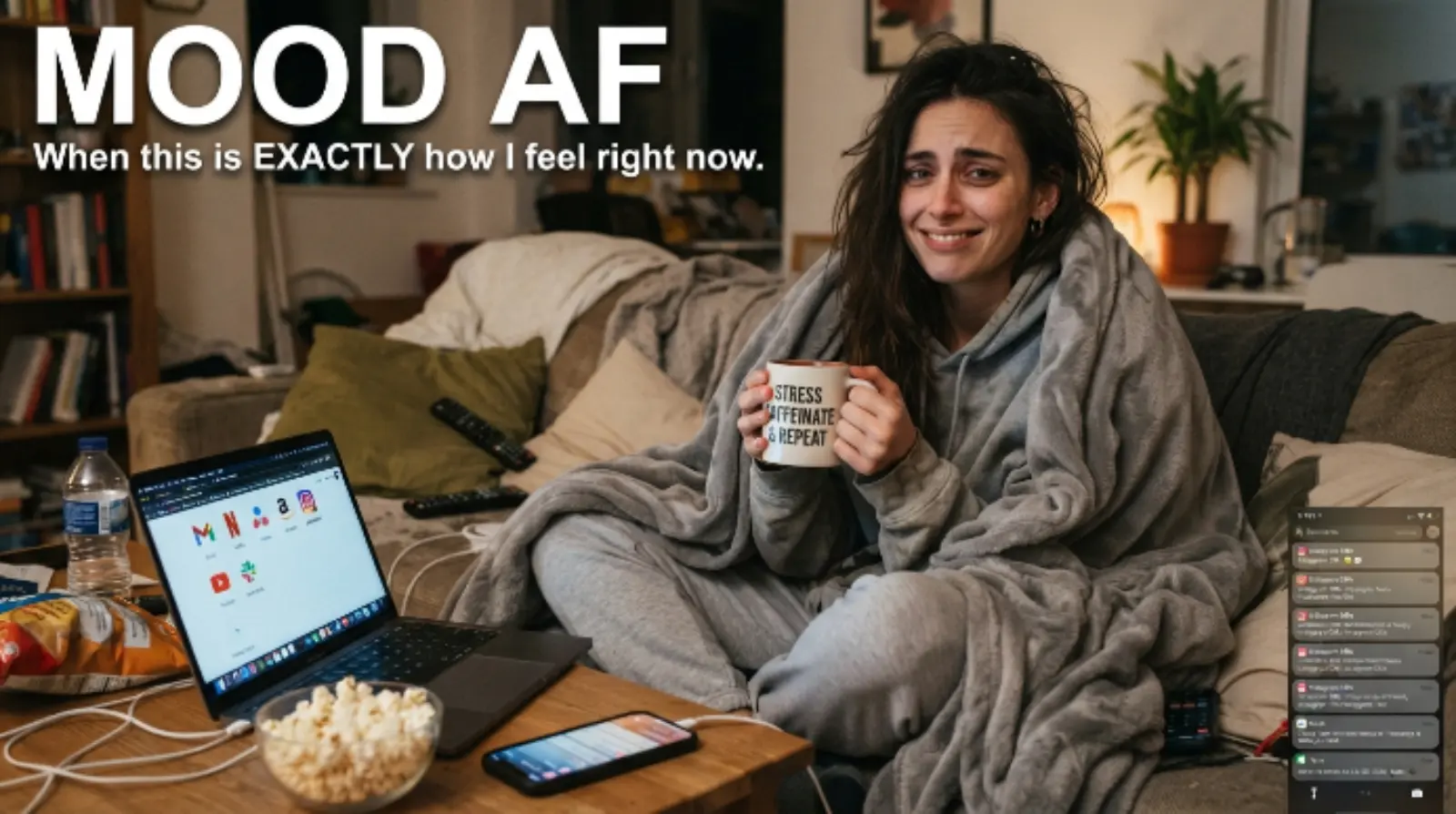
You’re scrolling through your feed at 1 a.m. You see a video of a raccoon aggressively washing a grape like its life depends on it. Without even thinking, you type “mood af” in the comments. Somehow those two words say everything you’re feeling without you having to explain a single thing. That’s the entire appeal of the mood af meme. It’s exactly why this tiny phrase has stuck around on the internet for close to a decade.
Mood af means “mood as f*”**, an intensified version of the internet slang word “mood.” When someone comments “mood af” under a post, they’re saying that content perfectly captures how they’re feeling right now. It often carries a heavy dose of relatable chaos, exhaustion, or emotional exaggeration. It’s not really about literal mood swings or feelings in the clinical sense — it’s about instant, gut-level relatability.
This guide breaks down exactly what “mood af” means and where it came from. It covers how the phrase is used across TikTok, Instagram, Twitter, and text messages, and how it differs from similar phrases like “big mood” or plain “same.” You’ll get realistic examples and common mistakes. You’ll also get answers to the questions people actually search when this phrase shows up on their screen and leaves them wondering what it means.
Quick Answer: What Does “Mood AF” Mean?
“Mood af” is short for “mood as f*,”** used to say something is extremely, intensely relatable. It’s typically posted as a caption or comment. It reacts to an image, video, or situation that perfectly mirrors how the poster is feeling in that moment.
The core building blocks are simple:
- Mood — internet slang for “this resonates with me” or “same energy”
- AF — short for “as f***,” used to intensify almost any word or phrase
Put together, “mood af” isn’t describing an actual emotional state like happiness or sadness. It’s describing a feeling of deep, sometimes exaggerated recognition — the internet’s version of nodding along and saying “yep, that’s exactly it.”
Where “Mood” (and “Mood AF”) Actually Came From
Before “mood af” became a meme staple, the standalone word “mood” had already been doing this exact job on the internet for years. Around 2016, “mood” started showing up as a one-word caption or comment. People used it the same way they’d once used “same” or “that’s so me” to signal relatability. Posting a photo of a lazy cat sprawled across a couch and captioning it “mood” became a quick way to say “this is basically my personality right now.” It was universally understood.
“AF” has its own separate history as internet shorthand for “as f***,” used to intensify practically any adjective — “tired af,” “cold af,” “extra af.” It became one of the most flexible intensifiers in casual online writing, largely because it works with almost any word you attach it to.
“Mood af” is what happens when these two pieces of slang merge. Instead of just saying something is relatable, “mood af” says it’s extremely relatable — dialing the emotional intensity up a notch. The phrase picked up serious traction as a caption for reaction memes and absurd videos. This is the kind of content that doesn’t just mildly resonate but hits you somewhere specific and immediate.
Why “Mood AF” Became a Meme Formula
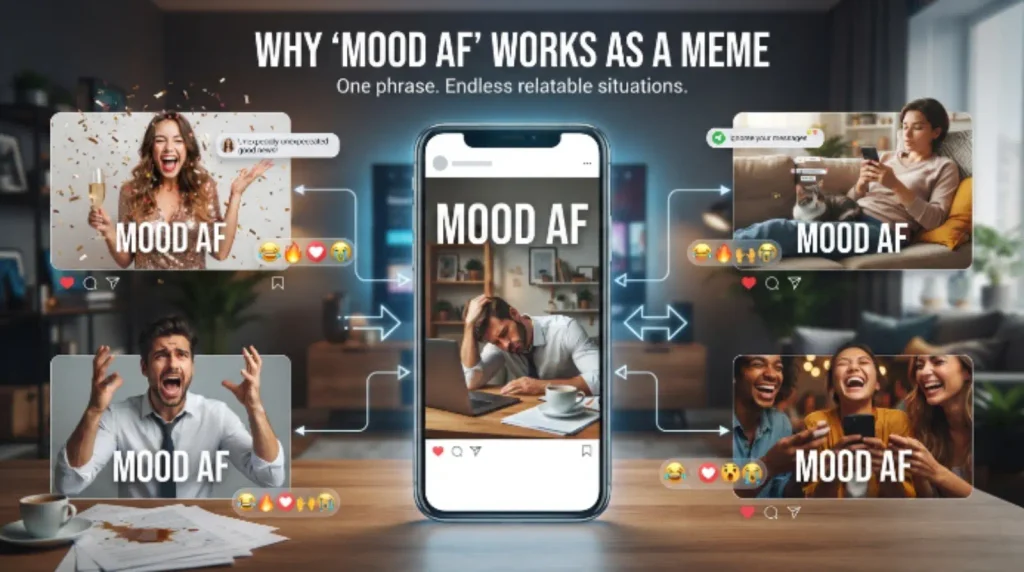
“Mood af” isn’t just a phrase — it evolved into a whole genre of meme. The format usually works like this: someone posts a video or image of something absurd, chaotic, exhausted, or oddly specific. They pair it with the caption “mood af.” The humor comes from the gap between how ridiculous the content is and how accurately it still captures a real feeling.
A viral example that shows up constantly in searches about this phrase involves a video of a gorilla throwing its own feces, captioned “mood af.” On the surface, it makes no logical sense — nobody’s mood literally resembles that. But that’s exactly the joke. The caption isn’t claiming a literal connection. It’s exaggerating for comedic effect, using shock or absurdity to represent frustration, chaos, or a rough day in a way plain words can’t quite capture.
This is a big part of why people search “what does mood af mean” after seeing it attached to something bizarre. The phrase works specifically because it doesn’t need to make literal sense — it just needs to land emotionally.
How “Mood AF” Is Used in Real Conversations
Seeing the phrase in context makes it click faster than any definition alone.
Example 1: Reacting to a relatable video
Person A: “just watched a video of a raccoon knocking everything off a shelf for no reason” Person B: “mood af honestly”
Here, Person B isn’t literally comparing themselves to a raccoon. They’re saying the chaotic, purposeless energy in that video matches how their day is going.
Example 2: Commenting under a meme
Caption: a photo of someone lying face-down on the floor next to a pile of laundry Comment: “mood af 😭”
This is the classic use case — a visual representation of burnout or exhaustion. It gets captioned with the exact phrase that sums up the feeling, with no further explanation needed.
Example 3: In a group chat
“it’s monday, i have three deadlines, and i already spilled coffee on my shirt” “mood af, I felt that in my soul”
In texting, “mood af” works as a quick way to validate someone else’s bad day by saying you’re right there with them.
Example 4: Self-deprecating caption
Someone posts a photo of their extremely messy desk with the caption “mood af for 2026”
Used this way, it’s less about reacting to someone else’s content and more about summing up your own current state of being.
“Mood AF” on Different Platforms
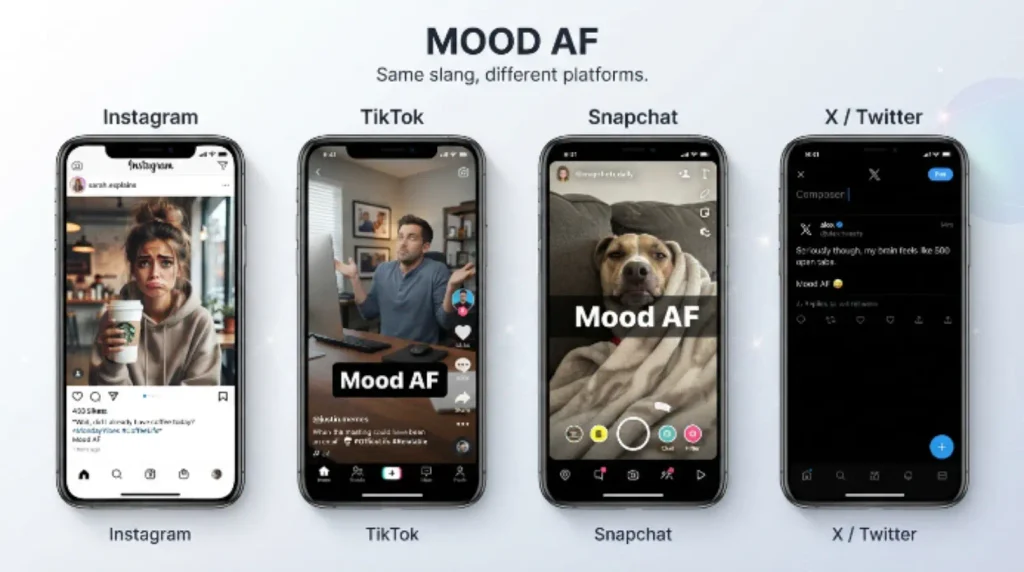
The phrase shows up constantly across social media, though the exact flavor shifts a little depending on where you’re scrolling.
TikTok
“Mood af” is a common caption on TikTok, especially under videos capturing chaotic pets, relatable adult struggles, or oddly specific situations viewers immediately recognize. It’s also become the subject of its own explainer videos, with creators breaking down what the phrase means for viewers unfamiliar with the slang.
On Instagram, “mood af” tends to show up in comments under memes and reaction posts. It also appears in captions on personal photos meant to be self-deprecating or funny rather than aspirational.
Twitter (X)
Twitter is arguably where “mood” culture originated as a broader internet phenomenon, and “mood af” fits naturally into quote-tweets and replies reacting to something painfully relatable.
Snapchat
Used more sparingly here, usually as a caption on a Snap capturing a chaotic or funny moment from someone’s actual day.
Discord and Reddit
In gaming servers and comment threads, “mood af” gets used similarly to react to screenshots, clips, or posts that capture shared frustration. Think a failed game run, a rough exam week, or an unreasonably relatable meme.
Texting and Group Chats
Here, it mostly functions as emotional shorthand between friends, validating a complaint or a bad day without needing a full explanation.
Dating Conversations
Less common here, but it can show up when someone shares something mildly self-deprecating. The other person can then respond with lighthearted relatability rather than a serious reply.
Workplace Communication
This phrase essentially never belongs in professional messaging. It’s casual, slightly crude by literal definition (since AF stands for “as f***”), and reads as out of place in anything formal.
Positive, Negative, or Neutral? Reading the Tone
“Mood af” carries a flexible tone that depends entirely on what it’s reacting to.
| Context | Likely Tone |
| Reacting to a funny, chaotic video | Playful, humorous |
| Captioning your own exhaustion or bad day | Self-deprecating, relatable |
| Responding to a friend’s complaint | Supportive, validating |
| Reacting to something absurd or gross | Ironic, comedic exaggeration |
| Reacting to something genuinely sad | Can lean more sincere, though this is less common |
Generally, the phrase leans lighthearted rather than serious. Even when it’s attached to something about stress, exhaustion, or a rough week, the tone usually stays light. It reads more like “we’re all struggling together, and it’s kind of funny” than genuinely distressed.
“Mood AF” vs. Similar Expressions
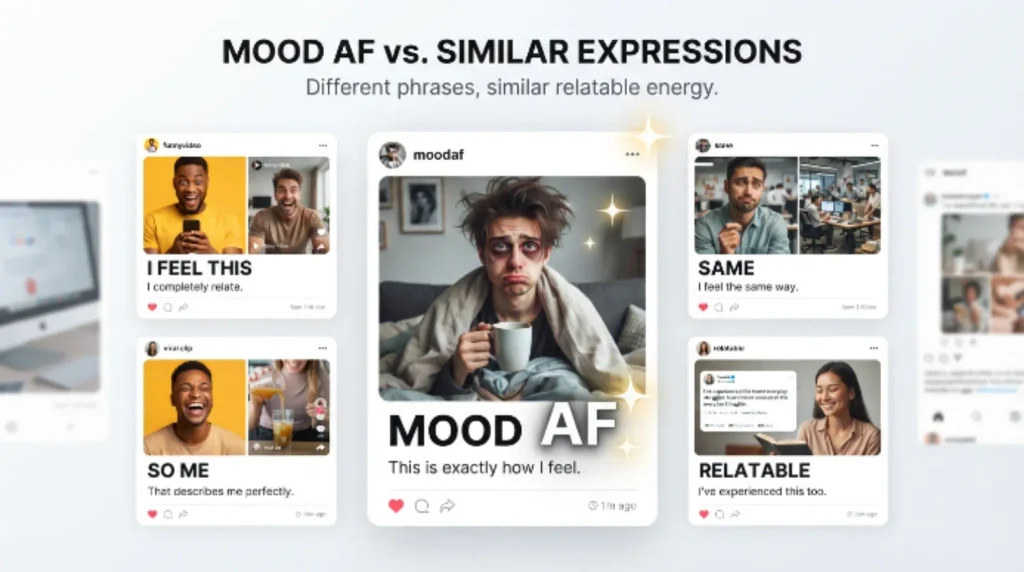
A handful of related phrases circle the same idea of relatability, but they’re not identical.
| Phrase | Meaning | How It Differs From “Mood AF” |
| Mood | Something is relatable | The base phrase, without the added intensity of “af” |
| Big mood | Something is extremely relatable | Similar intensity to “mood af,” different phrasing style |
| Same | Agreement or shared experience | More literal, less tied to meme culture or exaggeration |
| That’s so me | Personal identification with something | Older, more general phrasing, not meme-specific |
| TFW (that feeling when) | Describes a specific relatable feeling | Sets up the scenario itself, rather than reacting to one |
“Mood af” and “big mood” are close enough in meaning that people often use them interchangeably. “Mood af” tends to show up more as a direct caption. “Big mood” often appears as a reply or comment underneath someone else’s post.
Common Mistakes People Make With “Mood AF”
- Taking it too literally. The phrase almost never means someone’s actual mood resembles the content exactly — it’s about the feeling behind it, not a literal comparison.
- Using it in professional or formal writing. Because “af” technically stands for “as f***,” this phrase belongs firmly in casual spaces, not emails or work chats.
- Assuming it always signals something negative. “Mood af” gets used for funny, chaotic, and even lightly positive relatable content, not just stress or exhaustion.
- Overusing it as a generic reaction. Like most internet slang, it loses impact if it’s attached to literally everything rather than genuinely relatable content.
- Missing the humor in absurd examples. Comments like “mood af” under something like a wild animal video are intentionally exaggerated for comedic effect, not meant to be analyzed too literally.
Why “Mood AF” Still Resonates Today
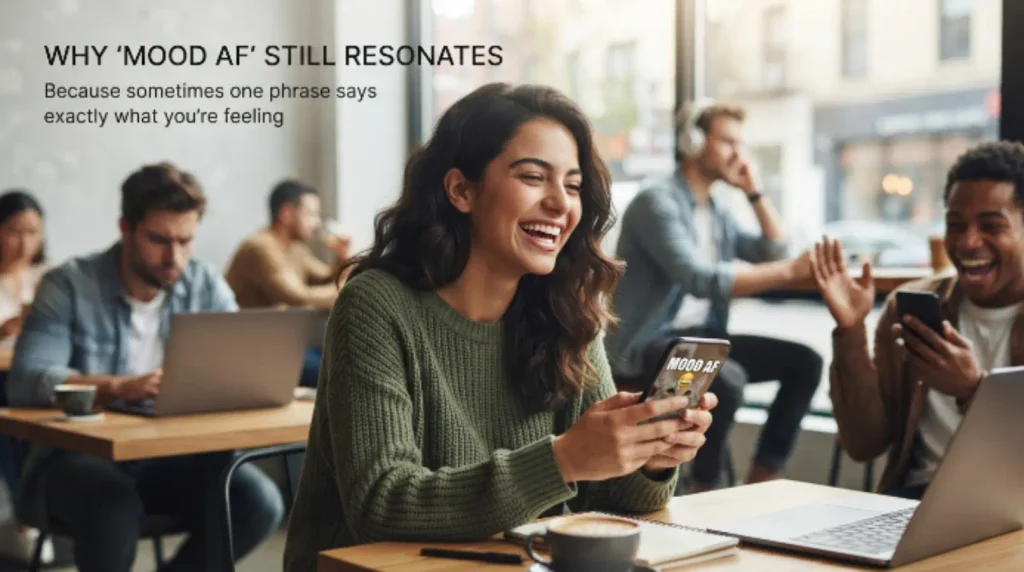
Even years after “mood” first took off as internet slang, “mood af” has stuck around. It fills a very specific gap: it lets people express complex, layered feelings — exhaustion, chaos, secondhand embarrassment, low-key despair — without writing out a paragraph explaining themselves.
Part of its staying power comes from how flexible it is. It works under a serious meme about adulthood struggles just as easily as it works under a video of an animal doing something ridiculous. That range is rare for internet slang, and it’s a big reason the phrase has outlasted plenty of other trends from the same era.
It also reflects something bigger about how people communicate online now. Reaction-based shorthand, built around shared cultural references and memes, often does the emotional work that a longer sentence used to do. “Mood af” isn’t really about mood in the dictionary sense — it’s about instant, communal recognition. That’s exactly why it keeps showing up in comment sections years after it first appeared.
Quick Reference Summary Table
| Category | Details |
| Phrase | Mood af |
| Meaning | “Mood as f***” — expressing intense relatability |
| Origin | “Mood” became relatability slang around 2016; “af” (as f***) is an older internet intensifier; the two merged into meme captions soon after |
| Common usage | Captions and comments on relatable, chaotic, or absurd memes and videos |
| Tone | Usually playful, self-deprecating, or comedic; rarely serious |
| Popularity | Well established across TikTok, Instagram, Twitter, and texting since the late 2010s |
| Related terms | Mood, big mood, same, TFW (that feeling when) |
| Best way to use it | As a caption or comment on something that captures a feeling instantly, without over-explaining |
Frequently Asked Questions
What does “mood af” mean in a text message? It means something is extremely relatable. The person is saying “that’s exactly how I feel right now” in an emphasized, casual way, using “af” to intensify the word “mood.”
Why do people comment “mood af” under weird or gross videos? It’s usually intentional comedic exaggeration. The person isn’t literally comparing their life to the video. They’re using the absurdity of the content to represent a feeling like frustration, chaos, or exhaustion in a funny way.
Is “mood af” the same as “big mood”? They’re very close in meaning and often used interchangeably. Both intensify the base word “mood.” “Mood af” tends to appear more as a caption, while “big mood” shows up more often as a reply.
Does “mood af” always mean something negative? No. It shows up under funny, chaotic, and lightly positive content just as often as it does under posts about exhaustion or stress. The tone depends entirely on what it’s reacting to.
Is “af” in “mood af” considered inappropriate? Since “af” technically stands for “as f***,” the phrase is casual and mildly crude by definition. That makes it unsuitable for formal or professional writing, even though it reads as fairly mild in everyday social media use.
Where did the word “mood” originally come from as internet slang? It gained popularity around 2016 as a one-word way to express relatability, similar to how people previously used “same” or “that’s so me.” It grew alongside the rise of reaction memes and meme culture more broadly.
Final Takeaway
The mood af meme boils down to one simple idea: intense, immediate relatability, usually delivered with a healthy dose of humor or self-deprecation. Whether it’s captioning a chaotic video, commenting under a meme about exhaustion, or validating a friend’s rough day in a group chat, “mood af” does the emotional heavy lifting in just two words.
Next time you see it attached to something that makes you laugh, sigh, or nod along a little too hard, you’ll know exactly what’s going on. Someone found content that captured a feeling they couldn’t quite put into their own words. So they borrowed the internet’s shorthand instead.

Basra Kamal is a content writer and researcher at Top Meaning, specializing in word meanings, abbreviations, internet slang, texting terms, and modern language trends. She is passionate about making complex words and online expressions easy to understand through clear, accurate, and well-researched content. Her work helps readers quickly find reliable explanations of popular terms, phrases, and acronyms used in everyday communication and digital culture.






2 thoughts on “Mood AF Meme: What It Means and Why It Took Over the Internet”