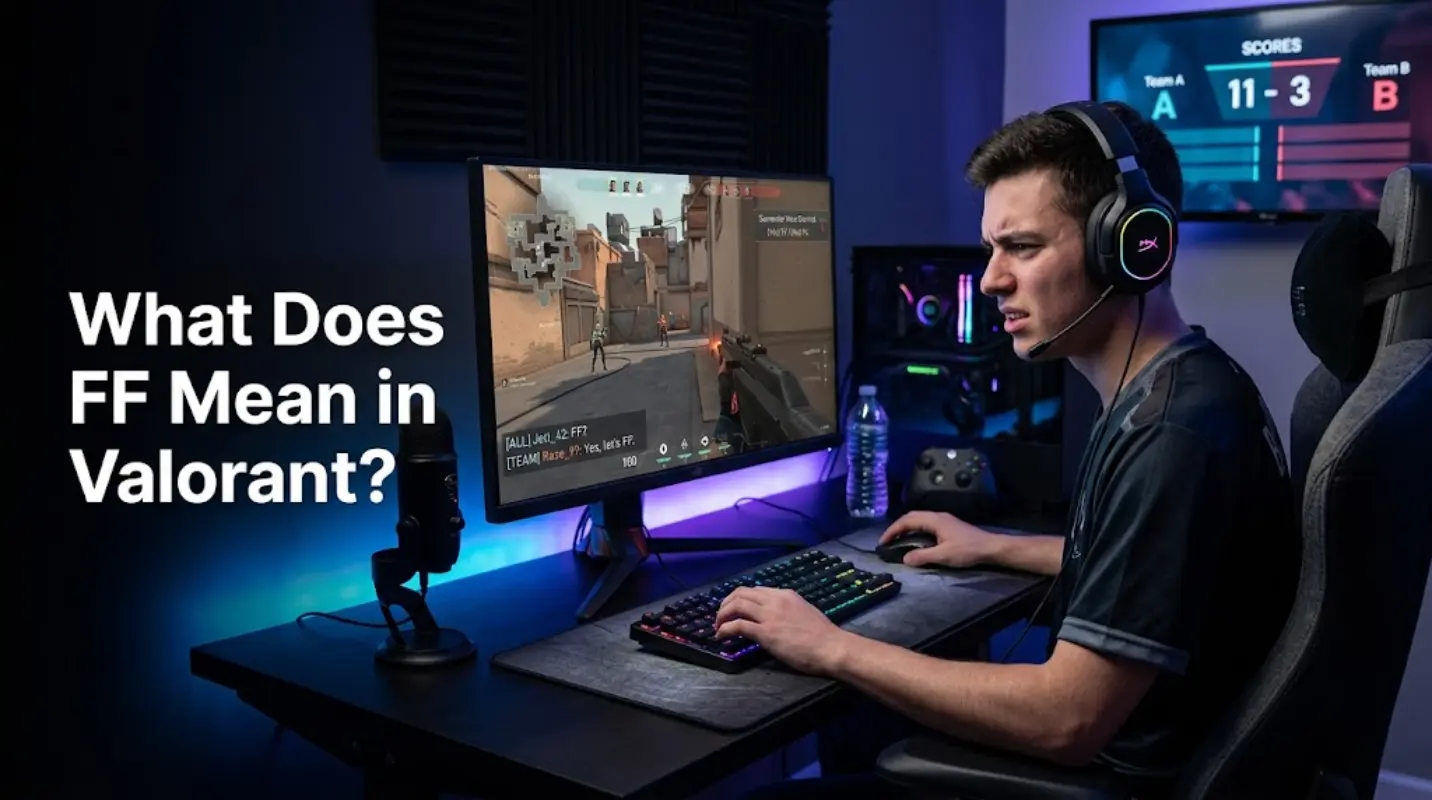
If you’ve ever dropped into a Valorant match, fallen behind 2-10, and watched your teammates start spamming a mysterious two-letter combo in chat, you’ve probably asked yourself: what does FF mean in Valorant? The short answer is that FF stands for “forfeit” — it’s the term players use when they want to surrender a match early instead of playing it out to the end. But there’s a lot more nuance to this simple abbreviation than meets the eye, and understanding it can genuinely change how you experience the game.
FF in Valorant isn’t just internet slang; it reflects a real (if unofficial) part of competitive gaming culture. Unlike games such as League of Legends or Dota 2, Valorant does not have a built-in surrender or forfeit button, which means “FF” functions more as a social signal than an actual game mechanic. That distinction trips up a lot of new players, and it’s the source of endless confusion, arguments, and even reports in ranked lobbies.
In this guide, we’ll break down exactly what FF means, where the term came from, how it’s used across different chat platforms and communities, why Valorant doesn’t officially support forfeiting, what happens when your team wants to FF, the etiquette (and misconceptions) around it, and how it compares to similar terms in other games. By the end, you’ll never be confused by an “FF” callout again.
Quick Answer: FF Meaning in Valorant
FF = Forfeit. When a player types “FF” in Valorant’s chat, they’re expressing a desire to give up on the current match rather than continue playing it to completion. It’s typically used when a team is significantly behind in rounds (for example, down 3-10 or worse) and believes the match is no longer winnable.
Here’s the catch: Valorant has no official surrender feature. Typing “FF” doesn’t end the match. It’s purely a chat-based suggestion, and the game continues regardless of how many players say it. This is one of the most important things to understand about the term, and we’ll dig into why Riot Games has designed it this way later in this article.
Where Does “FF” Come From? Origin and History
The term “FF” didn’t originate with Valorant. It has a long history in online multiplayer gaming that stretches back well over a decade.
The Roots in League of Legends and MOBAs
“FF” became mainstream gaming slang primarily through League of Legends, where players can literally type /ff or /surrender in chat to trigger an in-game vote to end the match early. In League, if a majority of the team agrees (after a set time threshold, usually around 15-20 minutes into the game), the match officially ends and counts as a loss.
Because League of Legends was one of the most-played competitive games of the 2010s, “FF” became deeply embedded in gaming vocabulary. Millions of players adopted it as shorthand not just for the literal in-game command, but as a general expression of “this game is over, let’s move on.”
How FF Migrated to Valorant
When Valorant launched in 2020, it inherited a massive influx of players from League of Legends, Counter-Strike, Overwatch, and other competitive titles — all communities where surrender culture and forfeit slang already existed. Players brought their vocabulary with them, and “FF” quickly became common shorthand in Valorant’s text and voice chat, even though the game’s developer, Riot Games, never built an actual forfeit system into it.
This is a great example of linguistic carryover in gaming culture — terms don’t need official support from a developer to become popular; they just need a community willing to use them consistently.
Does Valorant Actually Have a Forfeit or Surrender Option?
This is the single most important clarification for new players: no, Valorant does not have a built-in surrender button or forfeit vote system, unlike League of Legends, Dota 2, or Overwatch 2 (which added a similar feature in some modes).
That means:
- Typing “FF” in chat does not end the match.
- There’s no /surrender command that functions mechanically.
- Even if all five teammates agree to FF, the game continues until someone actually wins 13 rounds (or the match ends via other standard win conditions).
- The only way to “leave early” is for individual players to disconnect or quit, which comes with its own consequences (more on that below).
Riot Games has addressed this directly in community discussions and patch commentary over the years, generally taking the stance that competitive integrity matters more than convenience — they don’t want players giving up on winnable games just because they’re behind in the early rounds. Valorant rounds can swing dramatically due to economy resets, agent ultimates, and clutch plays, so a team down 3-9 is not necessarily doomed.
Why Doesn’t Valorant Let You Forfeit?
This is a frequently asked follow-up question, and it’s worth exploring the game-design reasoning behind it.
- Round-based comebacks are common. Valorant’s economy system (buying weapons, armor, and abilities each round) means a losing team can reset their economy, force-buy strategically, or capitalize on the enemy’s mistakes to stage a comeback. Games have been won from 3-11 deficits.
- Preventing quitter culture. If Valorant allowed easy forfeits, Riot worries it could encourage players to give up too early, robbing both teams of a fair, competitive experience.
- Protecting the losing team’s rank in some cases. Sometimes a “losing” team benefits more from finishing the game (and possibly clawing back rounds) than from an instant, guaranteed loss.
- Reducing toxicity incentives. Surrender systems in other games are sometimes used to bully or pressure struggling teammates. Not having one removes that particular avenue of harassment.
What Happens When Someone Says “FF” in Valorant?
Since there’s no mechanical effect, “FF” in Valorant chat serves a few real, practical purposes:
- A social signal of surrender — “I think we’ve lost, let’s not try as hard.”
- A tilt indicator — often used out of frustration after a costly round loss.
- A request to teammates to stop trying, sometimes controversially, since not everyone agrees.
- A prelude to leaving the match, since a player who feels the game is unwinnable might disconnect afterward (which is generally discouraged and can result in penalties).
Realistic Chat Examples
Here’s what this looks like in an actual match:
Teammate A: “ff this game is over” Teammate B: “bro it’s only 2-6, we can come back” Teammate A: “nah ff, gg”
Or in a more toxic scenario:
Teammate C: “ff report our duelist” Teammate D: “just play it out, don’t be that guy”
And a more constructive version:
Teammate E: “ff vibes ngl but let’s at least get to half” Teammate F: “fr, no reason to throw more, let’s regroup”
FF vs. Leaving/Dodging: What’s the Difference?
A lot of players confuse “FF” with actually quitting the match. These are two very different things, and understanding the distinction matters if you want to avoid penalties.
| Action | What It Means | In-Game Consequence |
| Typing “FF” | Verbal/text expression of wanting to give up | None — the match continues |
| Leaving the match | Actually disconnecting or quitting | Penalties: rank restrictions, queue timers, potential competitive cooldowns |
| AFK (away from keyboard) | Not participating without leaving | Can trigger automated AFK penalties |
| Dodging (leaving during agent select) | Quitting before the match starts | Smaller penalty than leaving mid-match, but still counts against you |
If your team says “FF” and you decide to leave the match as a result, you’re the one who gets penalized — not your teammates who typed it. This is a common and costly misunderstanding for newer players.
FF Etiquette: Unwritten Rules of Valorant Culture
Because “FF” carries no mechanical weight, its usage is governed entirely by community norms — and those norms vary depending on the lobby, rank, and mode.
When It’s Generally Considered Acceptable
- The score is heavily lopsided (e.g., 2-11 or worse) and the team’s economy is completely broken.
- It’s used as a lighthearted comment rather than a demand.
- Everyone on the team seems to agree the round/game state is unwinnable.
When It’s Considered Poor Etiquette (or Toxic)
- Saying “FF” after just one or two round losses.
- Using it to pressure teammates into throwing (intentionally losing) the rest of the match.
- Repeating it excessively, which can be reported as chat abuse or unsportsmanlike conduct.
- Saying it in Ranked or Competitive queues where a loss has real rank consequences for everyone, not just the person typing it.
Pro Tip for New Players
If a teammate says “FF,” you’re under no obligation to stop trying. Riot’s ranking and penalty systems don’t reward giving up, and plenty of matches have been won after a rocky start. Playing it out is almost always the statistically smarter move.
Common Misconceptions About FF in Valorant
- “If enough people type FF, the match ends.” False — there is no vote-based surrender mechanism.
- “FF is an official Riot command.” False — it’s purely community slang with no coded function.
- “Saying FF gets you penalized.” False — chat messages alone don’t trigger penalties (though repeated toxic behavior can be reported).
- “FF always means the game is unwinnable.” False — it’s a subjective, often emotional statement, not a statistical fact.
- “Only bad players say FF.” False — even high-rank and professional-adjacent players use the term casually, though pros rarely mean it literally in competitive matches.
FF in Other Contexts: Text, Social Media, and Beyond Valorant
Since “FF” appears in many corners of internet culture, it’s worth clarifying its other common meanings so you don’t mix them up.
FF in General Gaming (Outside Valorant)
- League of Legends / Dota 2: Literal surrender command (/ff), which actually functions mechanically.
- Overwatch 2 / other team shooters: Sometimes used the same way — a chat-based “let’s give up” signal.
- Final Fantasy games: “FF” is also shorthand for the Final Fantasy franchise (e.g., “FF7,” “FF14”), a totally unrelated meaning that context makes obvious.
FF on Social Media, Texting, and Other Platforms
- Twitter/X: “FF” historically meant “Follow Friday,” a weekly trend where users recommended accounts to follow.
- Instagram: Occasionally used the same way as Twitter’s Follow Friday, though this usage has faded.
- TikTok/Snapchat/Discord (general slang): “FF” can mean “fast forward” in casual conversation, unrelated to gaming.
- Texting/dating apps: Rarely used, but if it appears, context (gaming vs. social) almost always clarifies the intended meaning.
- Reddit gaming communities: Nearly always used in the “forfeit” sense when discussing competitive multiplayer games.
Quick Disambiguation Table
| Platform/Context | Likely Meaning of “FF” |
| Valorant / League of Legends / competitive gaming | Forfeit / surrender |
| Twitter (older posts) / Instagram | Follow Friday |
| Casual texting | Fast forward |
| Final Fantasy fan communities | Final Fantasy (the franchise) |
| Discord gaming servers | Forfeit (almost always, in a gaming context) |
Tone, Popularity, and Cultural Relevance
“FF” is casual, low-effort slang — it’s not formal, not rude by default, but it can carry a frustrated or defeated tone depending on how and when it’s used. Its popularity has grown alongside the explosion of competitive team-based shooters, and it now functions as near-universal shorthand across the gaming world, even in games (like Valorant) where it has zero mechanical effect.
Culturally, “FF” also reflects something bigger: the tension between individual frustration and team accountability in competitive gaming. Because Valorant is a 5v5 team game with no forfeit mechanic, saying “FF” is really a request for social cooperation — and how your team responds to that request says a lot about your group’s mentality and chemistry.
Summary Table: FF in Valorant at a Glance
| Category | Details |
| Meaning | “Forfeit” — a request or statement to give up on the current match |
| Origin | Popularized by League of Legends’ literal /ff surrender command |
| In-Game Function in Valorant | None — purely chat-based slang with no mechanical effect |
| Common Usage | Typed in team chat when a team is significantly behind |
| Tone | Casual, sometimes frustrated or tilted |
| Popularity | Extremely common across competitive multiplayer gaming |
| Consequences of Typing It | None directly; leaving the match afterward can trigger penalties |
| Alternate Meanings | Follow Friday (social media), Fast Forward (texting), Final Fantasy (gaming franchise) |
| Related Terms | GG (good game), AFK, throw, tilt, surrender, dodge |
Related Terms Every Valorant Player Should Know
- GG (Good Game): Said at the end of a match, win or lose, as a sign of sportsmanship.
- Tilt: Emotional frustration that leads to worse decision-making — often the real reason someone types “FF.”
- Throw: Intentionally playing poorly to lose the match, sometimes following an “FF” comment.
- AFK: Away from keyboard; not actively playing.
- Smurf: A high-skill player using a lower-ranked account, sometimes blamed (fairly or not) for lopsided matches that lead to FF chatter.
Frequently Asked Questions About FF in Valorant
1. Can you actually surrender a match in Valorant? No. Valorant has no official surrender or forfeit feature. “FF” is purely a chat expression, and matches must be played to their natural conclusion (typically first to 13 rounds, or overtime if tied).
2. What happens if my whole team types FF? Nothing changes mechanically. The match continues regardless of how many players say “FF” in chat. The only way the game ends early is through standard win conditions or if players start leaving (which carries penalties).
3. Will I get banned or penalized for saying FF? Simply typing “FF” does not result in penalties. However, if it’s part of a pattern of toxic behavior, harassment, or if you use it to justify intentionally throwing the game, you could be reported and reviewed under Riot’s conduct policies.
4. Is it bad to leave a match after someone says FF? Yes, generally. If you disconnect or leave the match, you’re the one subject to competitive penalties — including rank restrictions and queue restrictions — regardless of what your teammates said in chat.
5. Why does League of Legends have a surrender option but Valorant doesn’t? League of Legends matches can run 30-45+ minutes, and a genuinely lost game can be a significant time sink, which justifies a formal surrender vote. Valorant matches are shorter and far more prone to dramatic round-by-round comebacks, so Riot has chosen not to implement a similar system.
6. Does FF mean the same thing in Valorant ranked and unrated modes? Yes, the term itself doesn’t change meaning, but its social weight differs. In Ranked/Competitive, “FF” carries more emotional charge because losses directly affect your rank, whereas in Unrated or casual modes, it’s often said more jokingly.
7. What should I say instead of FF if my team is struggling? Try something constructive like “let’s reset and save this round” or “let’s at least try to get to half” — this keeps morale higher and avoids demoralizing teammates who might still want to fight for a comeback.
Coclusion
So, what does FF mean in Valorant? At its core, it’s simply short for “forfeit” — a piece of gaming slang borrowed from games like League of Legends, used to express that a player or team wants to give up on a match that feels unwinnable. But because Valorant has no actual surrender mechanic, typing “FF” has zero effect on the game itself. It’s a social gesture, not a game command.
Here’s what to remember:
- FF = forfeit, almost always in a Valorant or competitive gaming context.
- There’s no forfeit button — the match continues no matter who types it or how many times.
- Leaving the match is different from saying FF, and only leaving carries actual penalties.
- Etiquette matters — using FF thoughtfully (or not using it at all when your team is still fighting) contributes to a healthier, less toxic gaming environment.
- Context clues matter outside gaming, since “FF” can mean Follow Friday, Fast Forward, or reference the Final Fantasy franchise depending on the platform.
The next time you see “ff” pop up in your Valorant chat, you’ll know exactly what your teammate means — and more importantly, you’ll understand why the game keeps going regardless. Whether you choose to keep grinding for a comeback or mentally check out for the rest of the round, at least now you’re making that call with the full picture.

Basra Kamal is a content writer and researcher at Top Meaning, specializing in word meanings, abbreviations, internet slang, texting terms, and modern language trends. She is passionate about making complex words and online expressions easy to understand through clear, accurate, and well-researched content. Her work helps readers quickly find reliable explanations of popular terms, phrases, and acronyms used in everyday communication and digital culture.









2 thoughts on “What Does FF Mean in Valorant? The Complete Guide to Forfeiting, Surrendering, and In-Game Slang”