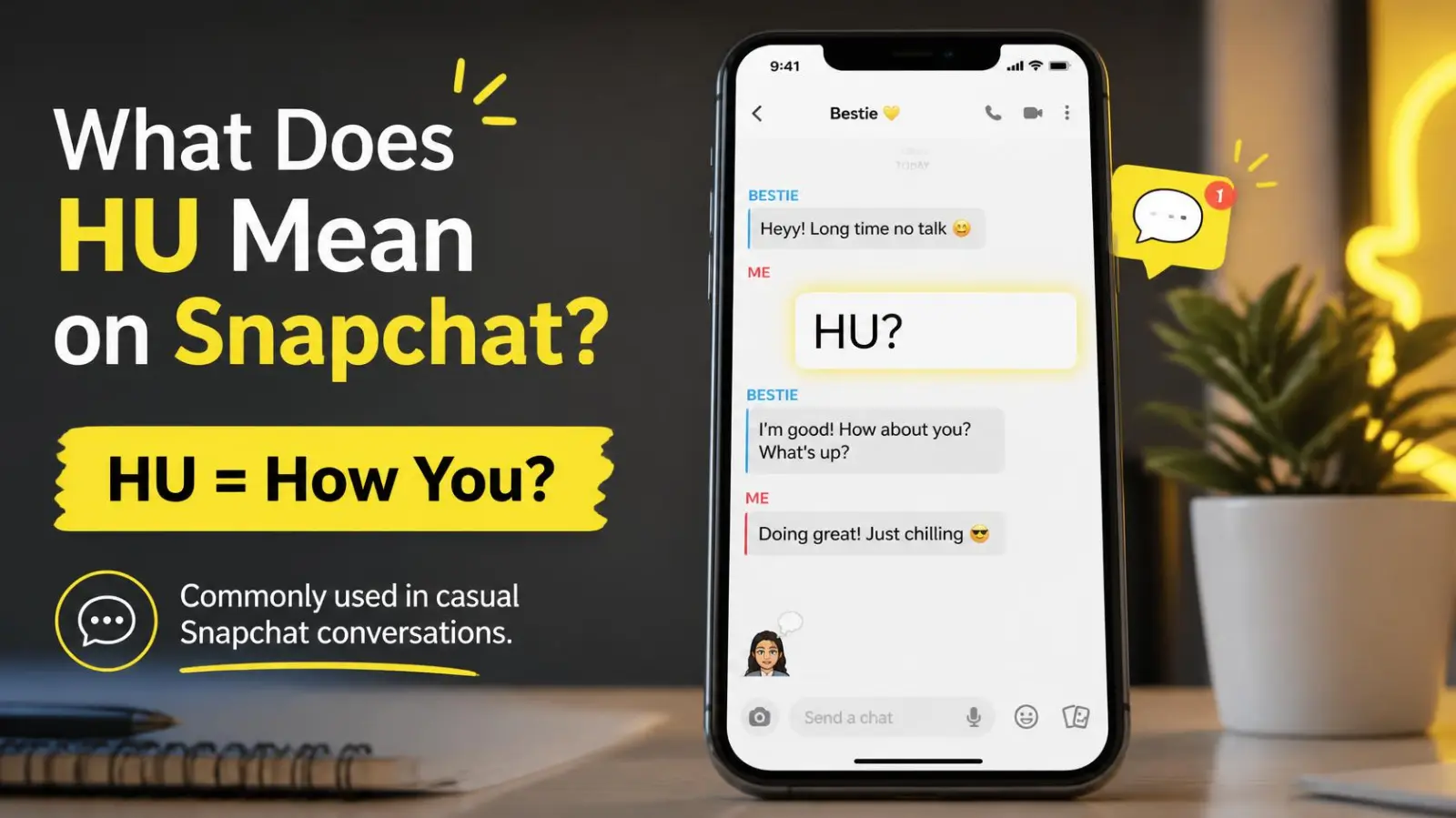
You’re scrolling through Snapchat, minding your business, and someone sends you a single message: “hu?” No punctuation, no context, no explanation. Just two letters staring back at you. So, what does “HU” mean in Snap?
Here’s the short version: HU most commonly stands for “hit up” or “hook up” on Snapchat, though it can also mean “who” or “hold up” depending on the conversation. It’s one of those tiny abbreviations that carries a surprising amount of weight — the meaning shifts based on who’s sending it, the tone of the chat, and what happened right before it landed in your inbox.
This guide breaks down every possible meaning of HU on Snapchat, ranked by how often each one actually shows up in real conversations. You’ll learn the origin of the term, how it’s used across Snapchat, Instagram, TikTok, Discord, Reddit, and texting in general, and how to reply without sending mixed signals. By the end, you won’t just know what HU means — you’ll know exactly how to use it (or avoid it) yourself.
What Does HU Mean in Snap? A Quick Answer
In most Snapchat conversations, HU means “hit up.” It’s a casual way of asking someone to message you, call you, or reconnect later — something like, “Hit me up when you’re free.”
The second most common meaning is “hook up,” used when someone is hinting at meeting in person, often in a dating or flirting context.
Less frequently, HU can mean “who” (asking about a person’s identity) or “hold up” (asking someone to wait a second). The correct meaning almost always depends on the sentence around it, so context is everything.
The Different Meanings of HU on Snapchat, Ranked by Popularity
HU isn’t a one-size-fits-all abbreviation. Here’s how the meanings break down, from most common to least common in Snapchat conversations specifically.
1. HU = “Hit Up” (Most Common)
This is the meaning you’ll run into the most on Snapchat. “Hit up” simply means to contact or message someone.
Example:
“hu me later, I’m free after 6”
This translates to: “Message me later, I’m free after 6.” It’s casual, low-pressure, and doesn’t carry any romantic weight on its own.
2. HU = “Hook Up” (Second Most Common)
In flirtier or dating-adjacent conversations, HU can mean “hook up” — referring to meeting up, going on a date, or getting physically closer.
Example:
“we should hu this weekend”
Here, the tone and prior conversation matter a lot. If the chat has been flirty, this almost certainly means “hook up” rather than “hit up.”
3. HU = “Who” (Common in Quick Replies)
Sometimes HU is just a fast, lowercase way of typing “who.” You’ll see this when someone is confused about who sent a Snap, who’s being talked about, or who’s involved in a story.
Example:
“hu is that in ur story”
Translation: “Who is that in your story?”
4. HU = “Hold Up” (Occasional)
Less common but still used, “hold up” means to wait a moment, often because something surprising just happened.
Example:
“hu, wait what happened”
5. Other Rare Meanings
- Hugged Up – slang for giving someone a hug, used mostly among close friends
- Heads Up – a quick warning, more common in group chats than in Snapchat DMs
- Harvard University – appears occasionally in bios, captions, or academic contexts
- Human – used in technical, scientific, or gaming contexts, rarely in casual chat
Where Does HU Come From? A Quick History
Like most internet slang, HU didn’t appear overnight. It evolved from longer, more common phrases that got shortened as texting and mobile chat culture took off.
The most widely accepted origin traces back to “hit me up,” a phrase that became popular in American texting culture during the early rise of mobile messaging and online chatrooms. Over time, people started dropping the “me” and “me up” got trimmed down even further, eventually landing on the two-letter version: HU.
Snapchat’s fast, disappearing-message format made this kind of shorthand even more useful. Since Snaps and chats often vanish after being viewed, users lean toward quick, low-effort replies — and HU fits that need perfectly. It’s essentially the text version of a confused or curious facial expression, condensed into two letters.
A separate, older meaning of “hook up” also fed into HU’s popularity, especially in flirting and dating contexts, giving the abbreviation its dual identity: practical on one hand, suggestive on the other.
How HU Is Used Across Different Platforms
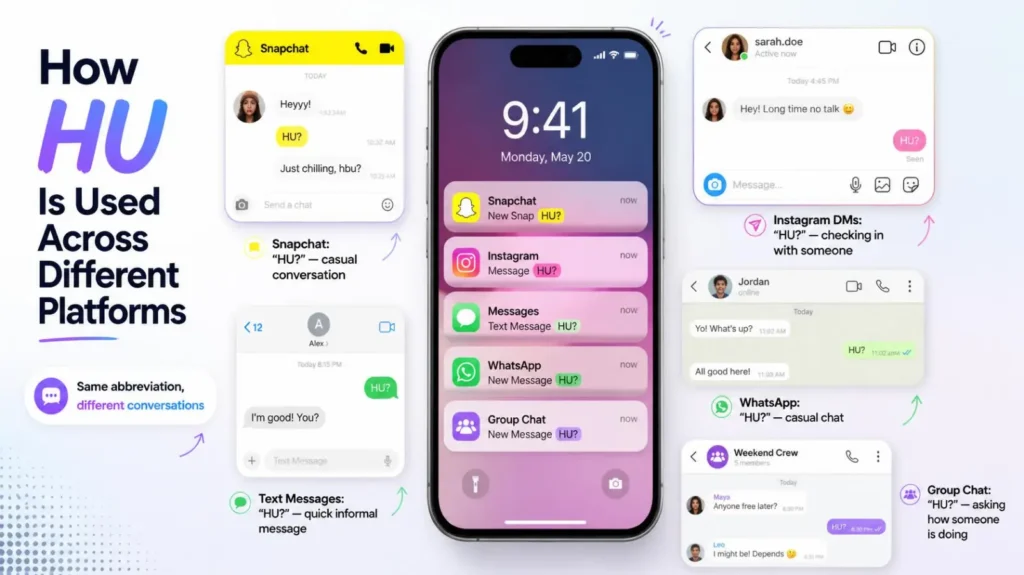
HU doesn’t mean the exact same thing everywhere. Here’s how its meaning shifts depending on where you see it.
HU on Snapchat
On Snapchat, HU is extremely common because conversations move fast and messages often disappear. It functions almost like a text-based reaction — similar to sending a confused-face emoji. It’s rarely overanalyzed here, and both “hit up” and “hook up” are common depending on the relationship between the two people chatting.
HU on Instagram and TikTok DMs
On Instagram and TikTok, HU often shows up as a reaction to content rather than a request to talk. If someone DMs you a wild video or meme with just “HU” as the caption, they’re usually saying, “Look at this, I’m confused or amazed.” It’s less about contact and more about commentary.
HU on Discord and in Gaming Chats
In gaming spaces like Discord, HU tends to mean “who” more often than “hit up.” Fast-paced games leave little room for full sentences, so players type “hu” when asking who did something, who’s on a team, or who’s talking.
Example:
“hu just killed me”
HU on Reddit
On Reddit, HU shows up less frequently since most conversations happen in public threads rather than private chats. When it does appear, it’s usually shorthand for “who” in comment replies, especially in fast-moving comment sections.
HU in Dating Apps and Flirting Conversations
This is where HU carries the most weight. In dating contexts, HU almost always leans toward “hook up,” and how it’s received depends heavily on the existing chemistry between two people. A dry “hu?” out of nowhere can feel like a red flag, while a playful “hu?” after a flirty exchange can feel like an invitation.
HU in Workplace or Professional Conversations
Simply put, avoid it. HU is casual slang, and using it in a professional email, work Slack channel, or client message can come across as unclear or unprofessional. Stick to full phrases like “let’s connect” or “reach out to me” in formal settings.
Real Conversation Examples: HU in Action
Seeing HU in real conversations makes the meaning click much faster than definitions alone.
Scenario 1: Casual Friend Chat
Friend: “hu tmrw? haven’t seen u in a min” You: “yeah for sure, lmk what time works”
Here, HU clearly means “hit up” — a friendly, no-pressure way to reconnect.
Scenario 2: Flirty Exchange
Crush: “we should hu this weekend 👀” You: “oh yeah? what’d you have in mind”
The emoji and tone shift this toward “hook up,” signaling interest beyond friendship.
Scenario 3: Story Reaction
Friend: “hu is that guy in ur story” You: “oh that’s just my cousin lol”
This is clearly “who,” used to ask about someone’s identity.
Scenario 4: Sudden News
Friend: “hu, wait they broke up??” You: “yeah it happened like an hour ago”
Here, HU functions as “hold up,” expressing surprise.
Common Mistakes People Make With HU
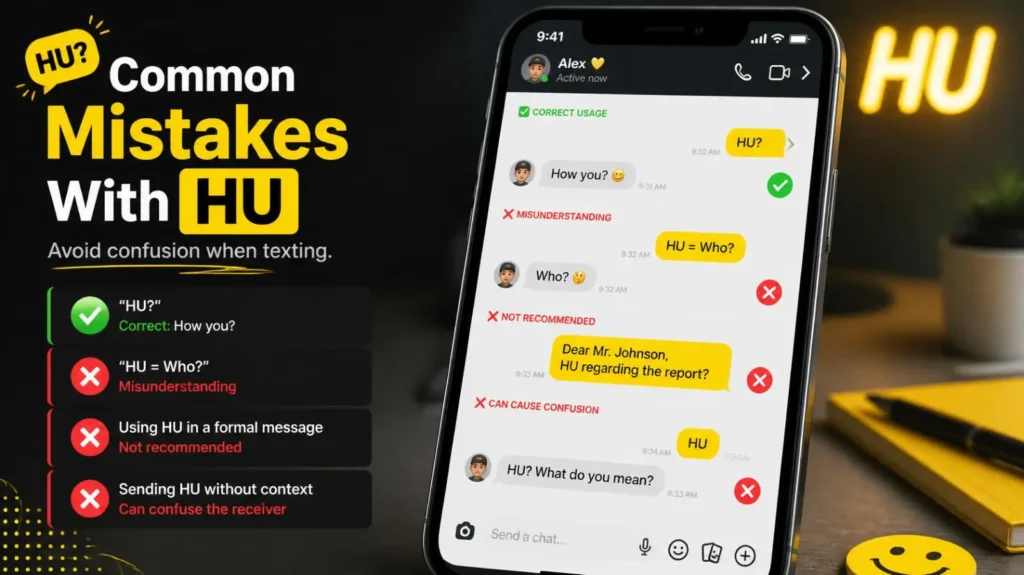
Even though HU seems simple, it trips people up more often than you’d think. Here are the most common slip-ups.
- Assuming there’s only one meaning. Context always changes the interpretation, so reading the full conversation matters more than the abbreviation itself.
- Using it in professional settings. HU instantly reads as too casual for work emails, client messages, or formal communication.
- Overanalyzing a single “hu” out of nowhere. Sometimes it really is just a quick, low-effort “let’s talk later,” not a hidden emotional message.
- Ignoring tone indicators. Emojis, punctuation, and capitalization all shift how HU should be read. “HU???” feels very different from “hu.”
- Replying with confusion instead of clarifying. If you’re unsure which meaning someone intends, it’s completely fine to ask directly instead of guessing.
Positive vs. Negative Connotations of HU
Like a lot of slang, HU isn’t inherently good or bad — the emotional weight depends entirely on the relationship and situation.
When HU feels positive:
- Reconnecting with a friend after a while
- Casual, friendly check-ins
- Playful flirting between two people who are already interested in each other
When HU can feel negative:
- A dry, one-word “hu” reply to a heartfelt or emotional message, which can feel dismissive
- Random “hu” texts from someone with no prior context, which can feel low-effort or vague
- Being used to avoid a real conversation or emotional vulnerability
Short slang like HU sometimes creates emotional distance on purpose. People often use it when they want to reach out without fully committing to a deeper conversation, so if a reply feels oddly short, that brevity itself might be the message.
HU vs. Similar Texting Abbreviations
It helps to see HU next to other common abbreviations to understand where it fits in the bigger picture of texting slang.
| Abbreviation | Meaning | Typical Tone | Common Platforms |
| HU | Hit up / Hook up / Who | Casual, sometimes flirty | Snapchat, Instagram, Discord |
| HMU | Hit me up | Casual, friendly | Texting, Snapchat, Instagram |
| HBU | How about you | Casual, conversational | Texting, group chats |
| WYD | What are you doing | Casual, curious | Snapchat, texting |
| IRL | In real life | Neutral, descriptive | All platforms |
| TBH | To be honest | Neutral, sincere | All platforms |
| BRB | Be right back | Neutral, functional | All platforms |
HU stands out because it’s shorter than most alternatives and carries more contextual ambiguity, which is exactly why so many people end up searching for its meaning in the first place.
Quick Summary Table: HU on Snapchat
| Category | Details |
| Most common meaning | Hit up (contact me later) |
| Second meaning | Hook up (meet up, dating context) |
| Other meanings | Who, hold up, hugged up, heads up |
| Origin | Shortened from “hit me up” |
| Popularity | Very common on Snapchat, Instagram, and Discord |
| Tone | Casual, informal |
| Best used with | Friends, casual acquaintances, dating interests |
| Avoid using in | Work emails, professional chats, formal messages |
| Related slang | HMU, HBU, WYD, TBH |
Misconceptions About HU
There are a few myths worth clearing up.
Misconception 1: HU always means something romantic. Not true. Most of the time, especially among friends, HU simply means “message me later.” Romance only enters the picture when the existing conversation already has flirty energy.
Misconception 2: A short “hu” reply always means someone is uninterested. Not necessarily. Some people default to short replies out of habit or personality, not because they’re annoyed or disinterested. Pattern matters more than a single message.
Misconception 3: HU is brand-new slang. It’s actually been around for years, evolving alongside texting culture since mobile messaging took off. It’s simply become more visible recently as older generations start encountering it more often.
Frequently Asked Questions About HU on Snapchat
What does it mean when someone texts you “hu” out of nowhere? It usually means they want to reconnect or chat, similar to “hit me up.” If there’s flirty history between you two, it could also lean toward “hook up.” Context and your prior relationship are the best clues.
Is “hu” the same as “hmu”? They’re closely related. Both usually mean “hit me up,” but HU is a shorter, more casual variation. HMU is slightly more common and considered a bit clearer since it spells out more of the phrase.
How do I reply to “hu” on Snapchat? Reply based on the meaning you believe fits the context. If it seems like a casual check-in, respond with your availability. If it feels flirty, you can playfully ask what they had in mind before committing to plans.
Is it rude to send someone “hu” with no other context? It’s not inherently rude, but it can come across as vague or low-effort, especially to someone you don’t talk to often. Adding a bit more context, like “hu, haven’t talked in a while,” softens the message.
Does HU mean something different from a guy versus a girl? The abbreviation itself doesn’t change, but tone and intent can differ based on the existing relationship, not gender specifically. The safest approach is judging by context rather than assumptions.
Can HU be used in a group chat? Yes, though it’s less common there. In group settings, HU is more likely to mean “who” (asking about a person) rather than “hit up” or “hook up,” since group chats are usually less personal.
Final Takeaway: What Does HU Mean in Snap?
So, what does HU mean in Snap? In the vast majority of cases, it means “hit up” — a casual, friendly way of asking someone to reach out or reconnect. In flirtier conversations, it often shifts toward “hook up,” and in quick, confused replies, it can simply mean “who.”
The real key to understanding HU isn’t memorizing every definition — it’s reading the context around it. Who sent it? What was the conversation like beforehand? Was there an emoji or extra punctuation attached? Those small details almost always reveal the intended meaning.
Slang like HU will keep evolving as texting culture changes, but the core idea stays the same: short, fast, and casual communication built for platforms like Snapchat. Next time “hu?” lands in your inbox, you’ll know exactly how to read it — and how to reply with confidence.

Basra Kamal is a content writer and researcher at Top Meaning, specializing in word meanings, abbreviations, internet slang, texting terms, and modern language trends. She is passionate about making complex words and online expressions easy to understand through clear, accurate, and well-researched content. Her work helps readers quickly find reliable explanations of popular terms, phrases, and acronyms used in everyday communication and digital culture.





2 thoughts on “What Does “HU” Mean in Snap? The Real Meaning Behind Snapchat’s Most Confusing Abbreviation”