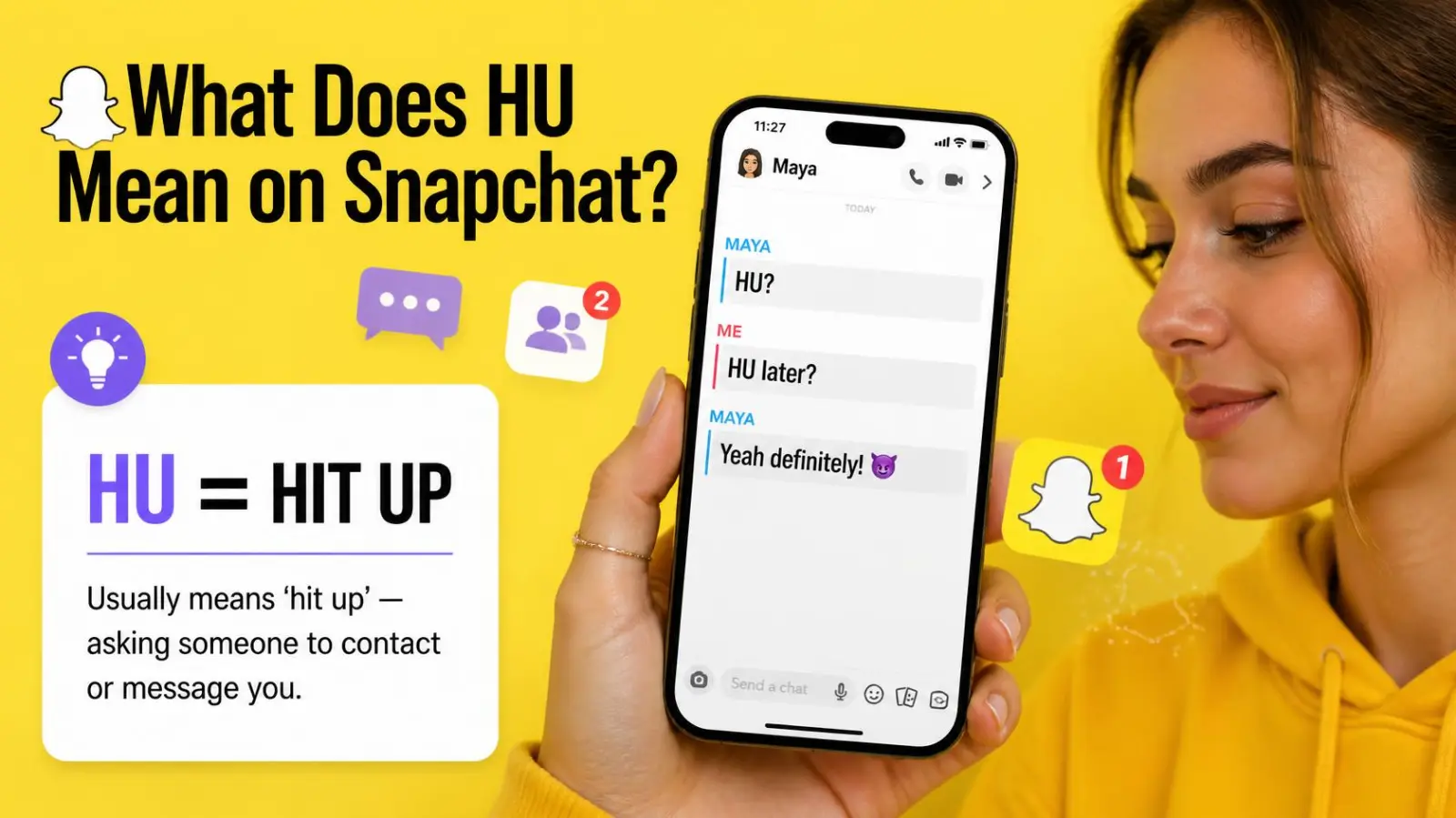
You’re mid-conversation on Snapchat, and a friend sends over a quick “HU?” with nothing else attached. No context, no punctuation, just two letters left hanging in your chat window. For anyone unfamiliar with the term, that short message can feel oddly confusing.
HU meaning on Snapchat is one of those slang questions that seems simple until you actually try to answer it. That’s because HU isn’t locked into a single definition. Depending on who sends it and what the conversation has been about, it usually means “Hit Up,” but it can also stand for “Hook Up” in more flirty exchanges, or occasionally “Hold Up” and “Who” in specific situations.
This guide walks through every common meaning of HU, ranked from most to least likely, along with real conversation snippets pulled from typical Snapchat exchanges, how HU compares to related terms like HMU, common mistakes people make when reading it, and practical advice for responding with confidence. By the time you finish reading, you’ll never have to second-guess those two letters again.
Quick Answer: What Does HU Mean?
HU stands for “Hit Up” in most Snapchat conversations. It’s a casual way of asking someone to reach out, reconnect, or message later. In dating or flirty contexts, it can instead mean “Hook Up.” Less frequently, it stands for “Hold Up” or simply “Who,” depending on the sentence around it.
The Letters Behind HU
- H stands for Hit
- U stands for Up
HU is essentially a trimmed-down version of the already-popular HMU, which stands for “Hit Me Up.” Dropping the middle word turns a three-letter acronym into an even faster two-letter one, which fits perfectly with Snapchat’s fast, disappearing message format.
How HU Came to Be
Slang terms like HU rarely have one clean origin story. They tend to evolve gradually as people look for faster ways to type common phrases.
Step one: the phrase itself. “Hit me up” has been part of everyday American slang for a long time, used whenever someone wants to invite future contact.
Step two: shortened for texting. As SMS and early messaging apps encouraged brief typing, “hit me up” naturally became HMU in casual conversation.
Step three: Snapchat speeds things up further. Since Snaps and chat messages are built around quick, temporary exchanges, users began trimming HMU down even more, eventually landing on the even shorter HU.
Step four: a second meaning develops. Because “hook up” carries similar casual, contact-focused energy, especially in dating conversations, HU picked up that meaning too, running parallel to its original “hit up” definition.
This isn’t a term that exploded from one viral post. It spread slowly, the way most practical texting shorthand does, through everyday group chats and DMs.
Ranking HU’s Meanings by Popularity
Since HU carries more than one real definition, here’s how they typically rank in everyday Snapchat use.
1. Hit Up — By Far the Most Common
This is what HU means the vast majority of the time. It’s a simple, low-pressure way to suggest reconnecting.
“HU when you’re free this week”
2. Hook Up — Common in Dating Contexts
When the surrounding conversation feels flirty or romantic, HU often shifts toward this meaning instead.
“We should HU this weekend 😉”
3. Hold Up — Occasional, Situational Use
Sometimes HU pops up as a quick way to signal surprise or ask someone to pause.
“HU, wait, run that by me again”
4. Who — Rare but Real
In fast typing or casual group chats, a small number of users shorten “who” down to HU as well.
“HU left this on read 💀”
Expert Note: If HU shows up without any surrounding context, “hit up” is almost always the safest assumption. The other meanings tend to make themselves obvious through tone and topic.
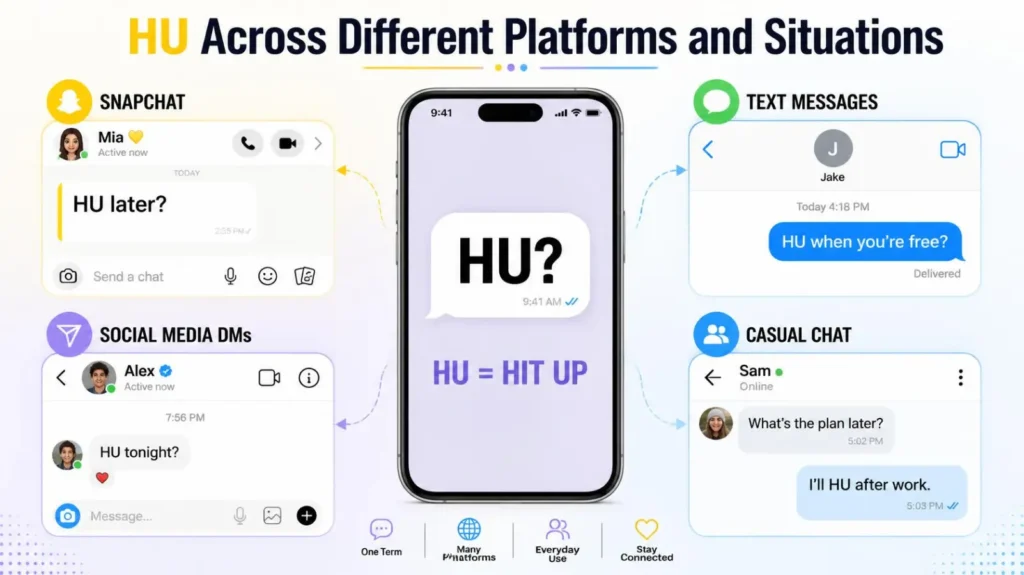
HU Across Different Platforms and Situations
In Regular Text Messages
Outside of Snapchat, HU generally keeps its core “hit up” meaning, often used when someone wants to reconnect after time apart.
On Snapchat Specifically
Because Snapchat thrives on casual, quick exchanges, HU shows up constantly here, more than almost any other platform.
“Haven’t heard from you in a min, HU?”
On Instagram
Instagram DMs use HU the same way, typically suggesting a continued conversation.
“HU, I meant to ask you something”
On TikTok
TikTok comment sections occasionally feature HU, usually inviting someone to continue a conversation that started under a video.
In Gaming and Discord Chats
Gaming communities use HU less frequently than Snapchat users do, but it still appears occasionally when coordinating plans to reconnect later.
In Dating App Conversations
This is where the “hook up” meaning shows up most reliably, especially when paired with playful language or emojis.
“You free later? We should HU”
In Workplace Messaging
HU rarely belongs in professional communication, but casual coworkers who text outside of work hours sometimes use it the same way as “hit up.”
Comparing HU to Similar Slang
| Term | Meaning | How It’s Different From HU |
| HU | Hit Up | Fastest, most casual version |
| HMU | Hit Me Up | Slightly longer, more universally recognized |
| WYA | Where You At | Asks about location, not contact |
| BRB | Be Right Back | Signals a pause, unrelated to reaching out |
| HBU | How About You | Redirects a question back to the sender |
The main difference between HU and HMU comes down to speed. Both mean the same thing, but HU trims even further, which is why it’s more common on fast-paced apps like Snapchat.
Conversation Examples Worth Knowing
Casual reconnect between friends
Riley: “It’s been forever, HU sometime” Devon: “Yes! This weekend works for me”
Flirty dating context
Sam: “You looked great in your last story” Casey: “Thank you 😏 we should HU”
Used as “hold up”
Jordan: “Wait, HU, you’re moving?!”
Used as “who”
Group chat: “HU keeps liking every single post 👀”
A Quick Reference Table
| Category | Details |
| Primary Meaning | Hit Up |
| Secondary Meaning | Hook Up |
| Occasional Meanings | Hold Up, Who |
| Origin | Shortened from HMU (“Hit Me Up”) |
| Most Common Platform | Snapchat |
| Overall Tone | Casual, occasionally flirty |
| Popularity | Widespread among younger Snapchat users |
| Related Terms | HMU, WYA, BRB, HBU |
| Ideal Setting | Friend groups, casual chats, dating conversations |
| Avoid Using In | Formal or workplace communication |
Mistakes Worth Avoiding
- Jumping straight to “hook up” as the default meaning. In reality, “hit up” is far more common across everyday conversations.
- Mixing up HU and HMU as separate terms. They’re essentially the same phrase, just shortened to different degrees.
- Ignoring the surrounding conversation. Context almost always clarifies which meaning applies, so it’s worth reading a few messages before assuming the worst.
- Dropping it into professional chats. HU is casual slang through and through, and it doesn’t translate well to formal settings.
The Emotional Tone Behind HU
On its own, HU carries a relaxed, low-stakes tone. It isn’t inherently flirty, rude, or negative.
- Casual and friendly: Most everyday uses simply suggest reconnecting without any deeper meaning.
- Flirtier undertones: In dating-adjacent conversations, especially paired with emojis, HU often leans toward “hook up.”
- Surprised or reactive: As “hold up,” it briefly interrupts a conversation rather than carrying any real weight.
None of these uses carry negative baggage. Whatever emotional tone comes through is shaped entirely by the conversation happening around it.
Responding to HU the Right Way
- If it’s a friend reaching out casually: “Definitely, I’ll message you later” works perfectly.
- If it feels flirty and you’re interested: Something like “For sure, let’s plan something” keeps the tone going.
- If you’re not sure what someone means: Asking directly, like “HU as in hit up, right?” is completely normal and avoids any awkward guessing.
There’s no obligation attached to receiving an HU message. It’s an invitation, not a demand.
Why This Kind of Slang Keeps Growing
The rise of terms like HU reflects how quickly digital communication keeps compressing. Snapchat’s disappearing message format practically encourages users to type fast without worrying about a permanent record, which pushes already-short phrases like “hit me up” into even shorter forms.
This pattern shows up across most messaging platforms popular with younger users, where speed and brevity often matter more than spelling things out completely.
Frequently Asked Questions
Does HU always mean “hook up” on Snapchat? No. While that meaning does exist, especially in dating conversations, “hit up” remains the far more common interpretation across everyday Snapchat use.
Is HU basically the same as HMU? Yes, essentially. HMU stands for “Hit Me Up,” and HU is simply a shorter, more casual version of that same phrase.
Should I assume HU is flirty every time I see it? Not necessarily. Look at the overall tone of the conversation. Casual chats between friends rarely carry flirty intent.
What if someone sends just “HU” with zero context? In that case, “hit up” is the safest default assumption, since it’s by far the most frequently used meaning.
Can HU mean “who” in a Snapchat conversation? Occasionally, yes, particularly in fast group chat typing, though this usage is far less common than “hit up.”
Is it okay to not respond right away to an HU message? Absolutely. HU is a casual suggestion, not an urgent request, so there’s no pressure to reply immediately.
Does HU mean something different on Instagram compared to Snapchat? Not really. The core meaning stays consistent across platforms, though it appears most frequently on Snapchat specifically.
Is HU appropriate to use with coworkers? It’s best kept to casual, non-professional conversations. Even coworkers who text casually outside work should avoid it in formal channels.
How can I tell if HU means “hold up” instead of “hit up”? Context makes this clear almost immediately. If it’s followed by a surprised reaction or a request to pause, “hold up” is the intended meaning.
Is HU newer slang, or has it been around a while? It grew gradually out of the older, more established phrase “hit me up,” gaining more visibility as Snapchat’s fast messaging culture pushed users toward shorter abbreviations.
Final Thoughts
At the end of the day, HU meaning on Snapchat almost always comes back to one simple idea: someone wants you to reach out. Whether that’s a friendly “hit up” or a flirtier “hook up,” the two letters themselves aren’t complicated once you know what to look for.
The next time HU shows up in your Snap chat, you’ll be able to read the context instantly and respond exactly the way you want to, whether that means planning to catch up, asking for clarification, or simply continuing the conversation from there.

Basra Kamal is a content writer and researcher at Top Meaning, specializing in word meanings, abbreviations, internet slang, texting terms, and modern language trends. She is passionate about making complex words and online expressions easy to understand through clear, accurate, and well-researched content. Her work helps readers quickly find reliable explanations of popular terms, phrases, and acronyms used in everyday communication and digital culture.





2 thoughts on “HU Meaning on Snapchat: What It Really Means and When to Use It”