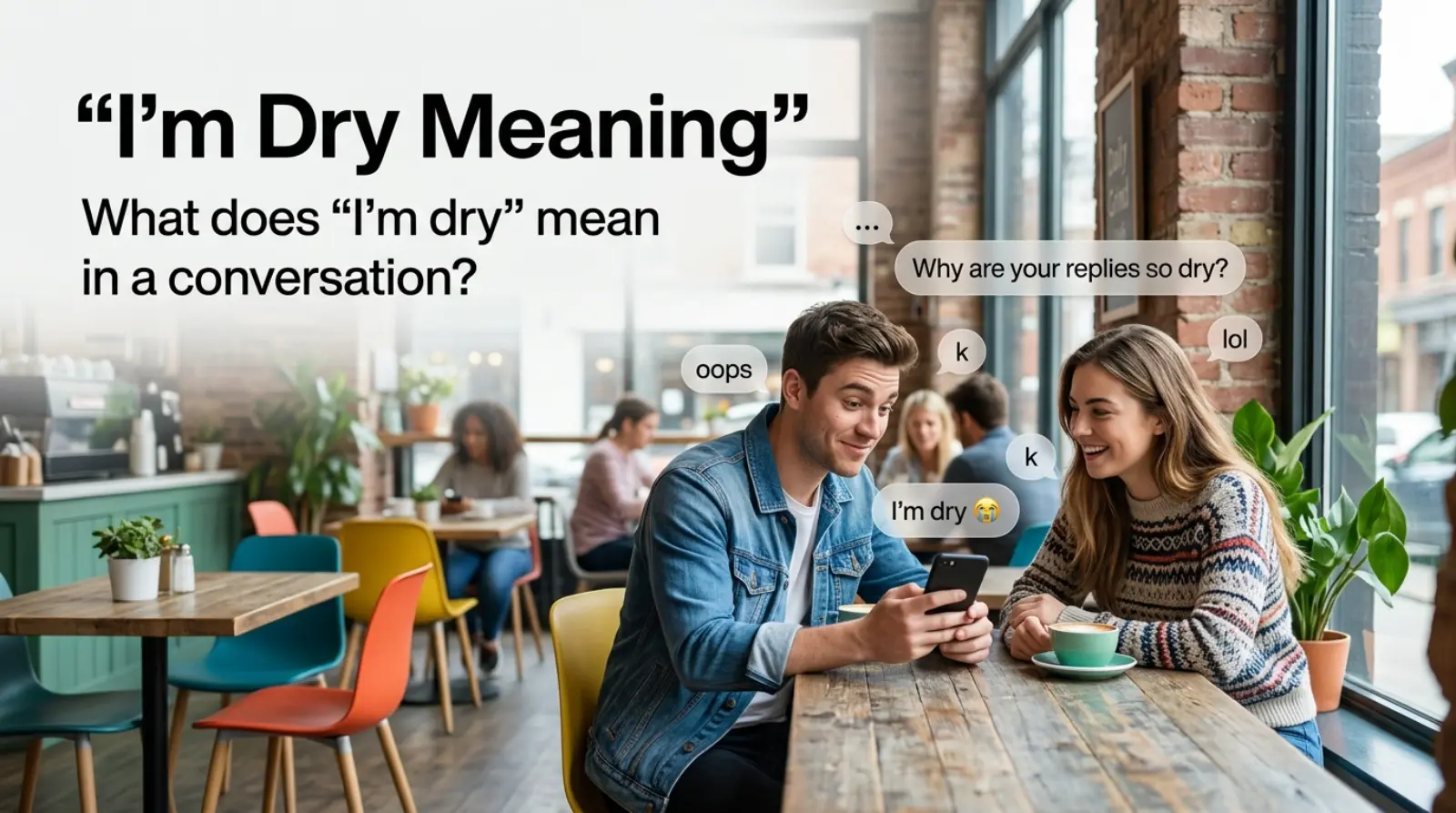
If someone’s ever texted you “lol I’m dry rn” or you’ve seen “dry texter” thrown around as an insult in your group chat, you’ve bumped into one of the most commonly misunderstood pieces of modern slang. So, what does “I’m dry” actually mean?
In short, “I’m dry” is slang used to describe someone (or something) as boring, unfunny, unenthusiastic, or lacking energy — most often in the context of texting, conversation, or humor. It can describe a person’s texting style (“he’s so dry”), a joke that didn’t land, or even someone admitting they’re in a low-energy, uninspired mood themselves (“I’m dry today, don’t mind me”).
This phrase shows up constantly across TikTok, Instagram, Snapchat, Discord, Reddit, and everyday texting, and it’s especially common in dating and texting culture, where being called a “dry texter” is a real (and often dreaded) label. But like a lot of slang, “I’m dry” carries several related meanings depending on tone, platform, and who’s saying it.
This guide breaks down every meaning of “I’m dry”, where the slang came from, how to use it correctly, common mistakes, and how it compares to similar expressions like “I’m dead” or “no cap.” By the end, you’ll never misread a “you’re dry” text again.
What Does “I’m Dry” Mean? (Quick Definition)
“I’m dry” is modern slang meaning boring, unfunny, unenthusiastic, or emotionally flat — typically used to describe a person’s conversational energy, sense of humor, or overall vibe in a given moment.
It can be used in three main directions:
- About yourself: “I’m dry today” = you’re feeling low-energy, unfunny, or uninspired
- About someone else: “He’s so dry” = they’re boring to talk to or their jokes fall flat
- About a text conversation: “This chat is dry” = the conversation lacks energy or interesting content
The word “dry” here is being used metaphorically — the same way “dry humor” has long meant deadpan or understated wit, except modern slang usage has shifted it to mean the absence of humor, energy, or personality rather than a specific comedic style.
Where Did “I’m Dry” Come From? Origin and Background
Unlike some internet slang with a clear single origin point, “dry” as a slang descriptor evolved gradually rather than appearing overnight from one viral moment.
The Linguistic Roots
The word “dry” has long been used in English to describe understated or deadpan humor — think “dry wit” or “dry sense of humor,” phrases that have existed for well over a century to describe subtle, low-key comedic delivery.
The Slang Shift
Sometime in the mid-to-late 2010s, particularly within Black American Vernacular English (AAVE) and youth texting culture, “dry” took on a broader and slightly different meaning: not just deadpan humor, but genuinely boring or unenergetic communication. This usage spread rapidly through texting culture, Twitter (now X), and group chats, where being called “dry” became a common callout for someone giving short, low-effort, or unenthusiastic responses.
Mainstream Popularization
By the early 2020s, “dry” and “I’m dry” were fully mainstream across:
- Texting and DMs — describing short, low-effort replies
- TikTok and Instagram comments — reacting to unfunny content
- Dating apps and dating culture — labeling bad texters
- Group chat culture — calling out someone’s energy in the conversation
Today, it’s one of the most commonly used slang terms for describing conversational or comedic energy — right up there with terms like “mid,” “flat,” and “no personality.”
The Different Meanings of “I’m Dry” (Ranked by Popularity)
Because this phrase gets used in slightly different ways, here’s a breakdown ordered from most to least common usage.
1. Describing a Boring or Low-Effort Texter (Most Common)
This is the single most common usage, especially in dating and casual texting contexts. A “dry texter” is someone who replies with short, low-effort messages like “lol,” “yeah,” or “k” — offering little to keep the conversation going.
Example conversation:
You: omg guess what happened today Crush: what You: [tells whole story] Crush: oh lol You (to a friend): he’s SO dry I can’t do this
2. Admitting Your Own Low Energy or Mood
People also use “I’m dry” self-referentially to explain that they’re not feeling talkative, funny, or engaged — often as a heads-up or an apology for seeming distant.
Example:
“sorry I’ve been so dry today, just tired”
3. Reacting to an Unfunny Joke or Comment
When something someone says or posts fails to land as funny, “dry” is a quick way to call it out — often good-naturedly, sometimes as gentle roasting.
Example:
Friend: [tells a joke] You: …that was dry ngl
4. Describing Content (Posts, Videos, Captions) as Boring
Beyond individual people, “dry” is frequently used to describe content itself — a caption, a video, a meme — as lacking humor, creativity, or engagement.
Example:
“this whole page has been dry lately, unfollowing”
5. Describing an Entire Vibe or Situation
Less commonly, “dry” can describe a broader situation, event, or atmosphere as flat or uneventful — similar to saying something was a “snoozefest.”
Example:
“the party was dry, we left after twenty minutes”
“I’m Dry” Across Platforms
In Texting and DMs
This is the phrase’s home turf. “Dry texting” and being labeled “a dry texter” is an extremely common complaint, especially in early dating conversations where one-word replies can kill a potential connection fast.
On TikTok
Commonly appears in comment sections reacting to content that didn’t land as funny or entertaining as intended: “ok this is dry” under a video that flopped.
On Instagram
Used similarly in comments and captions, often self-deprecatingly (“posting because I’m bored, this caption is dry ik”) or as light commentary on someone else’s content.
On Snapchat
Frequently used in private chats to call out a friend’s low-effort snap replies or lack of engagement in a conversation.
On Discord
In gaming and community servers, “dry” often describes chat energy in general — a quiet, unenthusiastic server or a member who rarely contributes anything engaging to conversations.
On Reddit
Shows up in relationship and dating advice threads constantly, particularly in discussions about whether someone’s texting habits are a red flag (“Is he just dry or does he not like me?”).
In Dating Culture
This might be the single most emotionally loaded use of the term. Being called “dry” in a dating context often signals a real compatibility concern — not necessarily that someone is a bad person, but that the conversational chemistry isn’t there.
In the Workplace
“Dry” is casual slang and generally not appropriate for professional communication. Describing a colleague’s presentation or a coworker as “dry” in a formal setting could easily come across as unprofessional or dismissive, even if it’s true in a casual sense.
Realistic Conversation Examples
Scenario 1 — Dating app text exchange:
Match: hey how’s your day going You: good you? Match: it’s alright. what are you up to this weekend You: nothing much Match (to friend, screenshotting): girl he is SO dry, one word answers all day
Scenario 2 — Friend group chat:
Friend 1: did anyone see the game last night??? Friend 2: yeah Friend 1: …that’s it? y’all are dry today lol
Scenario 3 — Self-aware admission:
“not me being dry all interview because I was nervous, hope they don’t think I’m boring”
“I’m Dry” vs. Similar Slang Expressions
| Term | Meaning | How It Differs From “Dry” |
| Dry | Boring, unfunny, low-energy communication | Focuses specifically on lack of energy, humor, or engagement |
| Mid | Mediocre, average, unimpressive | Broader — describes overall quality, not just conversational energy |
| Flat | Emotionally unexpressive or lifeless delivery | Similar, but often used for tone of voice or performance rather than texting |
| Basic | Unoriginal, generic, predictable | Refers to lack of individuality, not lack of energy specifically |
| No personality | Lacking distinctive character or humor | Broader personality critique, sometimes harsher than “dry” |
| Cap / No cap | Lying / not lying | Completely unrelated meaning — often confused by newcomers to slang |
Key distinction: “Dry” is specifically about energy and engagement in communication, while terms like “mid” or “basic” are broader quality judgments that don’t necessarily involve conversational effort.
Positive and Negative Connotations
Negative Connotations (Most Common)
- Suggests someone is boring, unengaged, or putting in low effort
- Frequently used as a dating red flag descriptor
- Can feel like a personal callout when used directly toward someone
- Repeated use toward the same person can come across as genuinely critical, not playful
Neutral or Self-Deprecating Use
- Often used lightheartedly to describe one’s own mood (“I’m dry today, ignore me”)
- Common as a low-stakes way to acknowledge you’re not bringing much energy to a conversation
- Rarely meant as a deep insult when self-applied — more of a casual disclaimer
Playful/Teasing Use
- Between close friends, calling someone “dry” for an unfunny joke is often affectionate ribbing rather than a genuine criticism
- Context and relationship closeness matter enormously here
Common Mistakes People Make With “I’m Dry”
- Confusing it with unrelated slang — “dry” has nothing to do with “thirsty” (which means desperate for attention), despite both being liquid-related metaphors.
- Using it in professional settings — it’s strictly casual slang and reads as unprofessional in work contexts.
- Taking it too personally when it’s meant playfully — context and relationship matter; a close friend calling you “dry” is usually a joke, not a real critique.
- Overusing it until it loses punch — like most slang, constant repetition dilutes its effect.
- Misreading self-referential use as an insult toward the listener — “I’m dry today” is about the speaker’s own mood, not a criticism of the other person.
Why “I’m Dry” Matters in Modern Communication Culture
Slang like “dry” exists because texting strips away tone of voice, facial expressions, and body language — the things that normally signal enthusiasm or humor in face-to-face conversation. “Dry” fills that gap by giving people quick, universally understood shorthand for describing conversational energy (or the lack of it).
It’s also become a meaningful part of modern dating culture specifically. In a world where early relationships are built largely over text before an in-person meeting even happens, texting style has become a genuine compatibility signal. Being labeled “dry” isn’t just a comment on humor — it’s often shorthand for “the chemistry isn’t translating to text,” which is a real and relatable dating frustration.
This is part of a broader pattern in internet slang: words that describe energy and vibe — “mid,” “flat,” “dry,” “no personality” — have become increasingly popular because so much modern communication happens through short, asynchronous text exchanges where energy is harder to convey and easier to judge.
“I’m Dry” Meaning: Quick Summary Table
| Category | Details |
| Meaning | Boring, unfunny, low-energy, or unenthusiastic (in texting, humor, or vibe) |
| Type | Slang expression / conversational descriptor |
| Origin | Rooted in older “dry humor” phrasing; slang shift popularized via AAVE and 2010s–2020s texting culture |
| Primary Use | Describing low-effort texters, unfunny jokes, or one’s own low energy |
| Common Platforms | Texting/DMs, TikTok, Instagram, Snapchat, Discord, Reddit |
| Tone | Casual; can be playful, self-deprecating, or genuinely critical depending on context |
| Popularity | Extremely common, especially in dating and texting culture |
| Related Terms | Dry texter, mid, flat, basic, no personality |
| Workplace Appropriate? | No — casual/informal slang only |
Frequently Asked Questions About “I’m Dry”
What does it mean when a girl says “I’m dry”?
It typically means she’s feeling low-energy, unfunny, or unenthusiastic in the moment — often used as a casual heads-up that she’s not bringing her usual personality to the conversation, rather than a comment directed at anyone else.
What does “dry texter” mean?
A “dry texter” is someone who consistently sends short, low-effort replies (like “lol,” “yeah,” or “k”) that don’t add much to keep a conversation going. It’s a common complaint in dating and casual texting contexts.
Is calling someone “dry” an insult?
It can be, depending on context and relationship. Between close friends, it’s often playful teasing about an unfunny joke or a boring moment. Directed at someone in a dating context or said with a harsh tone, it can feel like a genuine criticism of their personality or effort.
What’s the difference between “dry” and “mid”?
“Dry” specifically refers to a lack of energy, humor, or engagement — especially in texting or conversation. “Mid” is a broader term meaning mediocre or unimpressive, and can apply to almost anything, not just communication style.
How do you respond if someone calls you dry?
There’s no single right response — it depends on tone and relationship. A playful callout can be met with humor (“okay fair, my bad, let me lock in”), while a more serious comment might be worth addressing directly if it’s affecting a relationship or friendship.
Does “I’m dry” have anything to do with being thirsty?
No, despite both being liquid-related metaphors, they mean opposite things in slang. “Thirsty” means desperate for attention or validation, while “dry” means lacking energy, humor, or engagement — the two terms aren’t connected.
Why do people say they’re “dry” in dating conversations specifically?
Texting strips away tone, facial expressions, and in-person chemistry, so “dry” has become popular shorthand for describing when a conversation just isn’t clicking over text — even if the in-person connection might be completely different.
Can “I’m dry” be used positively?
It’s rarely used as a compliment, but it can be used lightheartedly and without malice — especially when someone self-deprecatingly admits they’re not bringing much energy that day. In that context, it’s more of a casual disclaimer than a real insult.
Is “dry” slang appropriate to use at work?
No, it’s considered casual internet and texting slang and isn’t suited for professional communication. Describing a colleague, meeting, or presentation as “dry” in a workplace setting could come across as unprofessional, even if accurate in a casual sense.
Where does the slang use of “dry” come from?
It evolved from the older, long-standing phrase “dry humor” (meaning deadpan wit), and shifted through AAVE and 2010s–2020s texting culture into its current, broader meaning of boring, low-effort, or unenthusiastic communication.
Conclusion
So, what does “I’m dry” really mean? At its heart, it’s modern slang for low energy, low effort, or a lack of humor — whether someone’s describing their own mood, calling out a boring joke, or labeling a texting partner whose replies just aren’t landing.
The phrase has become especially significant in dating and texting culture, where conversational energy over text has turned into a genuine relationship signal. Understanding whether “dry” is being used playfully, self-deprecatingly, or as a real critique comes down to reading context, tone, and the relationship between the people involved.
Now that you know its origin, its different meanings, and how it shows up across texting, TikTok, Discord, and dating apps, you’re equipped to use — and interpret — “I’m dry” correctly the next time it shows up in your notifications.

Basra Kamal is a content writer and researcher at Top Meaning, specializing in word meanings, abbreviations, internet slang, texting terms, and modern language trends. She is passionate about making complex words and online expressions easy to understand through clear, accurate, and well-researched content. Her work helps readers quickly find reliable explanations of popular terms, phrases, and acronyms used in everyday communication and digital culture.



1 thought on ““I’m Dry” Meaning: What This Popular Slang Really Means in Texting and Social Media”